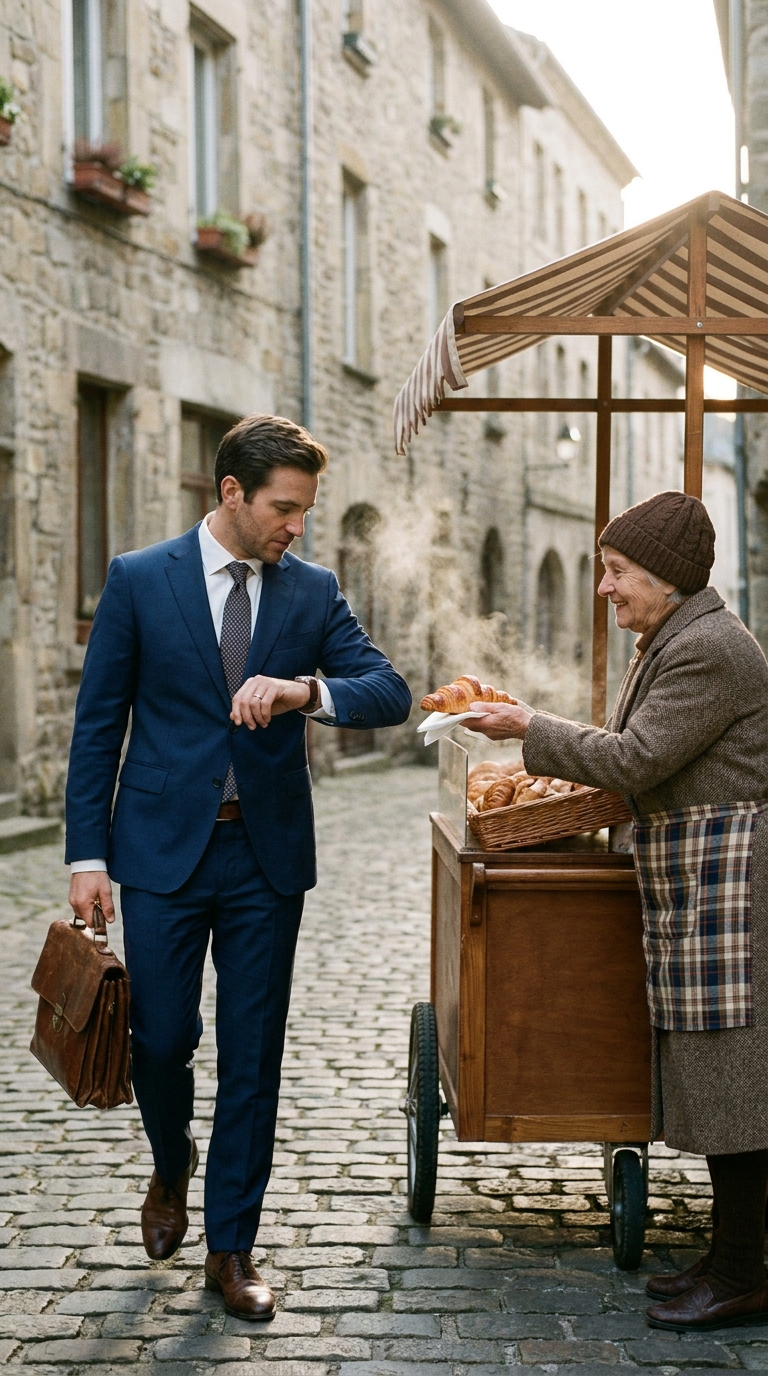
The old woman did not correct him right away.
That was what frightened him most.
She only looked at his face with the quiet grief of someone who knew exactly how long a lie could live inside a child and still call itself truth.
The man’s breathing grew uneven.
“My mother died in a fire,” he said, but this time it sounded less like fact and more like something repeated too often. “I was told she died when I was three.”
The old woman’s hand tightened on the edge of the cart.
“No,” she said softly. “You were told that because it was easier than telling you she was poor.”
The woman in the tan coat went still.
The street moved around them—bicycles, footsteps, distant bells—but their little corner of cobblestone felt sealed away from time.
The man shook his head.
“That’s impossible.”
The old woman took the photograph back carefully, as if it were still alive.
“You were born two streets from here,” she said. “Your mother sold pastries from this cart. She made the apricot ones only for you because you hated everything else. You used to sit under the counter and steal powdered sugar with both hands.”
His face changed.
Another flash of memory struck him.
A woman laughing.
A blue scarf.
A warm hand around his wrist.
A voice calling him “my little sparrow.”
He pressed one hand to his chest like the memory had hurt him physically.
The old woman saw it and nodded through tears.
“You remember.”
He stared at her.
“Who are you?”
Her lips trembled.
“I was her sister.”
The words landed gently, but the damage they caused was violent.
His aunt.
A person he had lived his whole life not knowing existed.
The woman in the tan coat looked at him with shock now, but he barely noticed. His eyes were fixed on the old woman’s face, searching for the child in the photo, the missing years, the mother he had been taught to mourn.
“What happened?” he whispered.
The old woman looked toward the narrow street behind the cart.
“Your father’s family happened.”
He went pale.
His father had been a powerful man. Cold. Respected. Careful with appearances. He had raised him in a house where his mother was a framed tragedy, not a person. A woman described only as delicate, unfortunate, gone.
The old woman continued, voice shaking but steady.
“They came after your father married into money. They said your mother was an embarrassment. A street seller. A stain on the family name. They offered her money to disappear, but she refused because she had you.”
The man’s fingers tightened around the pastry.
“She would never leave you,” the old woman said. “So they took you.”
He stopped breathing.
Not died.
Taken.
The word split his life open.
The old woman reached under the cart and pulled out a small tin box, dented at the corners. Inside were dozens of tiny folded notes, brittle with age.
“She wrote you one every morning after they took you,” she said. “She placed a pastry beside the window and said, ‘He’ll come home hungry.’”
The man looked down at the notes.
Some were addressed to a child.
Some to a teenager.
Some to a grown man she had never seen.
His hand shook as he lifted one.
My little sparrow, today the apricots were sweet. I made three. One for me, one for your aunt, and one for you. I still don’t know if you remember the taste, but I will keep making them until you do.
The man’s eyes flooded.
He tried to speak but couldn’t.
The old woman wiped her cheek with the back of her hand.
“She stood at that window every morning for twenty-three years.”
He looked up sharply.
“Stood?”
The old woman’s face broke.
“She died five years ago.”
The sentence moved through him slowly, cruelly.
His mother had not died when he was three.
She had lived.
She had waited.
And he had been alive across the city, wearing tailored suits, building his father’s empire, believing the woman who loved him was already buried.
He turned away, one hand covering his mouth, but grief found him anyway.
The polished man on the street cracked in front of strangers.
The old woman stepped closer, holding the black-and-white photograph to her chest.
“She made me promise something before she died.”
He looked at her through tears.
“She said if you ever came back, I should not ask why it took so long.” Her voice broke. “Only feed you first.”
That destroyed him.
The pastry slipped from his hand onto the white napkin.
He dropped to his knees on the cobblestone, not caring about his suit, his watch, the people watching, or the woman beside him.
For the first time in his life, he did not look like a wealthy man.
He looked like a lost son.
“I didn’t know,” he whispered. “I swear I didn’t know.”
The old woman finally touched his face.
Her hand was rough, warm, and trembling.
“She knew,” she said. “A mother knows when her child has been lied to.”
He closed his eyes and leaned into the touch like a starving child leaning toward bread.
Then the old woman opened the tin again and took out one final envelope.
Unlike the others, this one had his full adult name written across it.
“She wrote this after she saw you once,” she said.
His eyes opened.
“Saw me?”
The old woman nodded toward the grand hotel at the end of the street.
“You walked past this cart eight years ago. In a black coat. Surrounded by men. You didn’t look our way.”
His face twisted in pain.
The old woman pressed the envelope into his hand.
“Your mother saw you. She smiled all day.”
He opened the letter with shaking fingers.
My son,
You looked healthy. You looked loved by the world, even if not by the right people. I wanted to call your name, but you looked like a man who had survived by forgetting. So I let you pass. Forgive me. I was afraid if I said your name and you did not know me, I would lose you twice.
The man folded over the letter, sobbing silently.
The woman in the tan coat touched his shoulder, but he stepped away from her gently.
He looked at the old pastry seller.
“What was her name?”
The old woman smiled through tears.
“Amara.”
He repeated it once.
“Amara.”
A name he had never been allowed to say.
A name that suddenly felt like home.
Then he looked at the pastry cart, the old buildings, the tray still warm with the food his mother had made every morning for a child who never came.
“What happens to this cart?” he asked.
The old woman gave a tired little shrug.
“I am old. The city wants it gone. They say old carts don’t belong on new streets.”
For the first time since the photograph appeared, something hardened in his face.
Not coldness.
Purpose.
He looked at the cart again, then at the street, then at the hotel where he had once walked past his mother without knowing.
“No,” he said quietly. “This cart stays.”
The old woman blinked.
He took out his phone, but stopped before calling. Instead, he looked back at her.
“No,” he corrected himself, voice breaking again. “Not a cart.”
He touched the worn wooden edge with reverence.
“A memorial.”
The old woman covered her mouth.
He turned toward the woman in the tan coat and spoke with the authority that had once served the wrong family.
“Cancel the meeting.”
Then he looked at his aunt.
“Take me to where she’s buried.”
The old woman nodded, tears falling freely now.
Before they left, she wrapped one more pastry in paper and placed it in his hand.
“For the road,” she whispered.
He held it like something sacred.
Then, on the old cobblestone street where his mother had waited every morning, the man in the navy suit finally took another bite.
This time, he did not taste pastry.
He tasted the childhood stolen from him.
And the love that had waited long after it was too late to be answered.