For a second, Mara could not understand the words.
They seemed too large for the tiny shop. Too impossible for a woman who had walked in begging for bread.
Ben looked up at her, confused.
“Mom?”
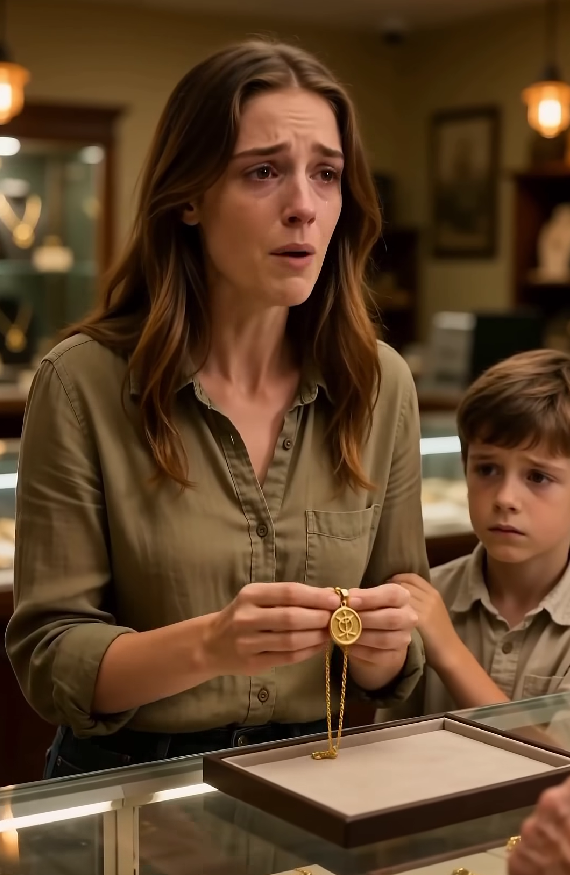
She stared at the old photograph, then at the pendant trembling in the jeweler’s hand.
“No,” she said softly. “My mother found me behind a church. She raised me alone.”
The jeweler nodded, tears gathering in his eyes.
“Yes,” he said. “And she must have loved you very much… because she kept you alive instead of giving you back to the people who paid to make you disappear.”
Mara felt the ground shift inside her.
He moved to a locked cabinet, opened it, and removed another photograph wrapped in cloth. This one showed a younger version of the same wealthy man, standing beside a smiling woman holding a newborn baby with a tiny gold chain around her neck.
The baby’s face meant nothing.
But the pendant did.
And on the back, written in faded ink, was one word:
Mara.
Her knees almost gave way.
Ben caught her shirt with both hands.
“Mom, are you okay?”
She couldn’t answer.
The jeweler’s voice shook as he continued.
“That man came every year. Every single year. He’d ask if anyone had brought the pendant in.” He looked at Ben, then back at her. “Last winter, he stopped coming. He was too sick to walk. But he left instructions.”
Mara’s throat tightened.
“What instructions?”
The jeweler opened the drawer again and took out a folded envelope.
“He said if a young woman ever came in with this pendant… I was to call him immediately and tell her one thing.”
Mara’s fingers trembled as she took the envelope.
Inside was a note, written by an unsteady hand:
If you are reading this, then you survived. I have searched for you in every face, every crowd, every year of my life. Forgive me for failing to protect you. Please come home, my daughter.
Mara broke.
Not with loud sobs at first.
Just one sharp inhale, one hand flying to her mouth, one unbearable silence as a lifetime of not knowing cracked open all at once.
Ben pressed close to her.
“Who wrote that?”
She looked down at him through tears.
“I think…” Her voice shattered. “I think your grandfather did.”
The little boy blinked, then glanced at the necklace.
“Because of that?”
Mara nodded.
The jeweler wiped his eyes and stepped closer.
“He still lives,” he said gently. “He’s in the old estate outside town. He’s dying, child. But he’s alive.”
Mara closed her hand around the pendant so tightly it hurt.
Just an hour ago, she had come ready to sell the last piece of her mother.
Now that same gold circle had opened a door buried for twenty-five years.
She looked at Ben’s tired face, at the hunger he was trying so hard not to mention, and then back at the jeweler.
“I came here to ask for bread,” she whispered.
The old man’s face crumpled with tenderness.
“Then let me give you something better.”
He reached beneath the counter, brought out a small paper bag of pastries, and placed it gently into Ben’s hands.
The boy looked at it like it was treasure.
Then the jeweler picked up the phone with trembling fingers.
Mara stood very still, tears still falling, as the shop filled with the quiet sound of the number being dialed.
And for the first time in her life, she realized the necklace had never been meant to feed her for one day.
It had been waiting to bring her back to the name that was stolen from her.