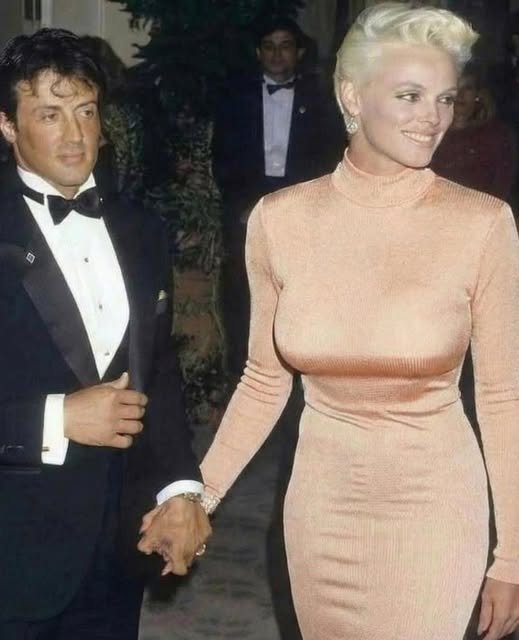
To understand the trajectory of Brigitte Nielsen is to watch a masterclass in survival. In an industry that treats women like perishable goods—valuing them only as long as they possess the bloom of youth—Nielsen has done something radical: she has refused to expire.
At sixty years old, she isn’t just “still around”; she is thriving with an unapologetic, magnetic energy that has made her a modern-day icon for anyone who feels that the world is trying to put them out to pasture.
The Original “It Girl” and the Cost of Fame
In the mid-1980s, Nielsen didn’t just walk into Hollywood; she dominated it. Standing six-foot-one with a statuesque, Amazonian grace, she was a neon-lit anomaly in a decade obsessed with excess. From her breakthrough in the sword-and-sorcery epic Red Sonja to her icy, unforgettable turn as Ludmilla Drago in Rocky IV, she was a force of nature.
But with the fame came the “Stallone factor.” Her whirlwind marriage to the biggest action star on the planet turned her into a permanent fixture of the tabloid press. In that era, the media didn’t just report on stars; they picked them apart. When the relationship ended after just two years, the scrutiny was brutal. She was painted by the headlines as a cautionary tale, a woman whose career was tethered to a man.
Most people in that position would have faded into obscurity, crushed by the weight of being “formerly known as.” Nielsen, however, had other plans.
The Art of the Comeback (And the “Full Circle”)
Nielsen didn’t retreat. She pivoted. She moved across the Atlantic, becoming a television mainstay in Europe, modeling, and essentially recalibrating her identity. She refused to let her narrative be written by gossip columns.
Then came 2018. When she stepped back into the Rocky universe for Creed II, it wasn’t just a nostalgic nod—it was a reclamation. Reprising the role of Ludmilla Drago was, for the audience, a trip down memory lane; for Nielsen, it was a victory lap. She returned to the character that had defined her early years, not as a wide-eyed newcomer, but as a seasoned veteran who finally owned her place in cinematic history.
The Power of Radical Honesty
What has truly endeared Nielsen to a new generation, however, is her refusal to pretend. In a 2014 sit-down with Oprah Winfrey, she did something most Hollywood stars fear: she laid her soul bare. She spoke about her battles with addiction, the suffocating loneliness of fame, and the paralyzing self-doubt that comes when the cameras stop flashing.
It was a masterclass in vulnerability. By owning her mistakes, she stripped the media of their power to define her. She proved that there is no shame in a messy life—only in the refusal to learn from it. This raw, unflinching honesty became her greatest asset, turning her into a relatable, human figure rather than a gilded, distant idol.
Rewriting the “Motherhood” Script
Perhaps the most head-turning chapter of her life occurred at fifty-four, when she welcomed her daughter, Frida. The world’s reaction was a mix of awe and judgmental disbelief. But for Nielsen, the birth was a declaration of defiance against the “biological clock” narrative. She didn’t let society’s arbitrary timeline for parenting dictate her reality. Her journey through late-in-life motherhood wasn’t about proving a point; it was about living on her own terms, proving that joy and fulfillment aren’t strictly reserved for our twenties and thirties.
The Aesthetic of Authenticity
Today, if you look at Nielsen’s social media, you won’t find the airbrushed, hyper-filtered masks that dominate Instagram. You’ll find a woman who is comfortable in her own skin—literally. She posts photos that show her age, her confidence, and her sheer vitality. She isn’t trying to look twenty-five again; she is trying to be the most authentic sixty-year-old she can be.
She has become a symbol of what many call “the third act”—that mysterious, powerful phase of life where you finally stop worrying about what everyone else thinks. She embodies a kind of beauty that isn’t about symmetry or smoothness, but about the hard-earned lines of experience and the steady gaze of someone who has stared down the limelight and survived to tell the tale.
Why She Matters Now
In a world increasingly obsessed with the “aesthetic of aging,” Brigitte Nielsen stands as a necessary antidote. She is a living reminder that resilience is not about remaining the same; it is about the courage to keep evolving.
She hasn’t just survived the Hollywood machine—she has mastered it. She reminds us that the best years aren’t necessarily the ones when you’re the most famous; they are the years when you’re the most you.
For anyone looking at the mirror and worrying about the passage of time, look at Brigitte Nielsen. She is the ultimate proof that you don’t need a fountain of youth when you have a well of self-assurance. She isn’t just aging gracefully; she’s aging loudly, boldly, and with a level of grace that makes the rest of the world sit up and take notice.
Her life is no longer a tabloid story—it’s a roadmap for reclaiming your power, at any age.