Part 1
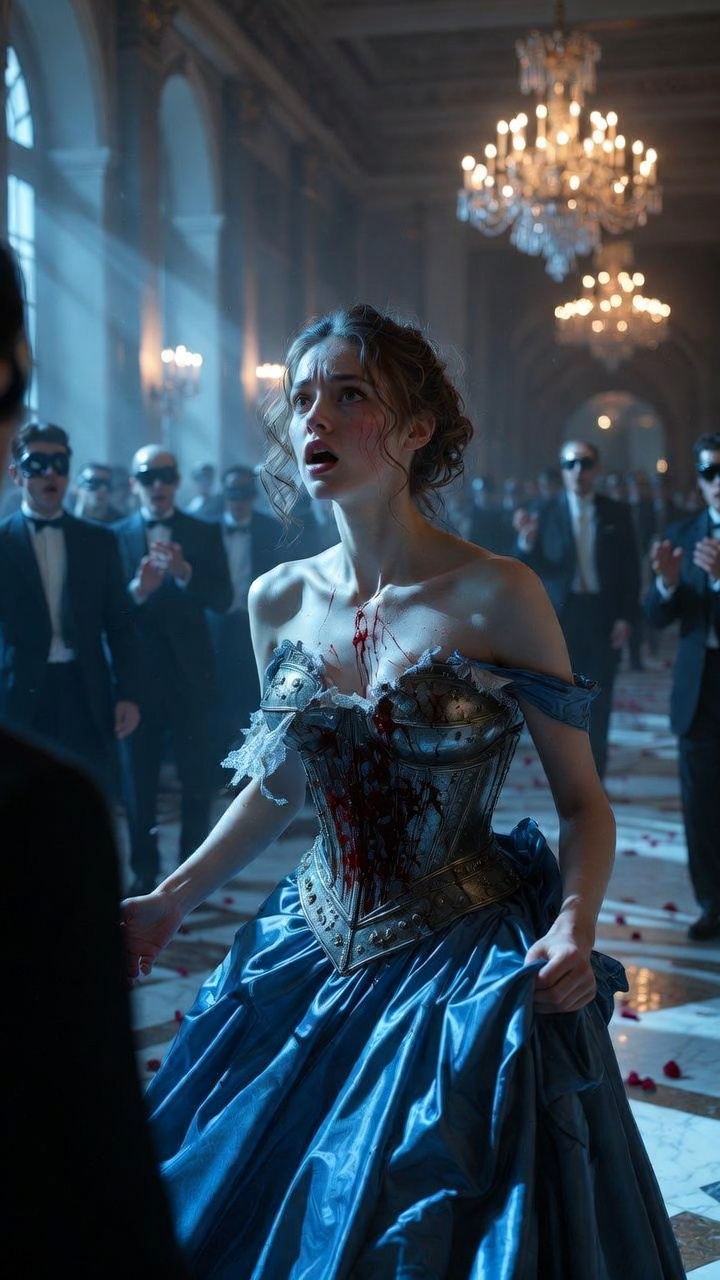
The scissors cut her dress… but they revealed something no one was ready for. SNIP.
The sound sliced through the ballroom louder than the music.
For one suspended moment, everything else seemed to fall behind it. The ballroom had been filled with music, with movement, with the kind of polished noise that makes people believe nothing ugly can happen in public.
Then came that sharp sound.
SNIP.
It was not part of the song. It was not part of the celebration. It was a cut, clean and sudden, and it reached every corner of the room before anyone could pretend they had not heard it.
The blue satin strap fell.
It did not fall loudly. It did not need to. The small drop of fabric carried more shock than any raised voice could have. One second, the dress had still been whole. The next, something had been severed in front of everyone.
The girl gasped.
There was no speech. No explanation. Only that breath, pulled from her before she could stop it, as if the cut had touched more than satin.
The music was still there, but it no longer felt like music. It became background noise to a moment that had turned too visible, too cruel, too impossible to ignore.
The scissors had already done what they came to do.
They had cut her dress.
They had taken the blue satin strap and made it fall.
And in the silence that followed inside that sound, the ballroom was no longer just a ballroom. It became a place where everyone could see her, where every eye seemed to understand that something had happened, but not yet what it meant.
The girl stood caught in the instant after the cut.
Her gasp remained in the air.
The strap was down.
The scissors had spoken before anyone else could.
And whatever they revealed, no one in that room was ready for it.
The sound had sliced through the ballroom louder than the music.
The girl gasped—
her hands…
Part 2
her hands flying to her chest as the torn satin slipped against her skin.
The ballroom stopped breathing.
For a few seconds, the humiliation was exactly what the blonde woman had wanted. The girl stood beneath the chandeliers with lowered eyes, one strap hanging loose, her fingers trembling as she tried to hold the dress together.
Soft laughter moved through the wealthy crowd.
It came from women in silk gowns and men holding untouched champagne glasses. It came from people who had seen cruelty before and called it entertainment when it happened to someone poor.
The blonde woman lowered the gold scissors at her side.
Her smile was polished, calm, almost proud.
“Girls like you don’t belong here,” she said.
The words landed harder than the cut.
The girl did not answer. She only stood there, cheeks burning, one tear slipping down before she could stop it. She had come to the gala quietly, wearing the only beautiful dress she owned, trying not to be noticed by people who measured worth by last names and diamonds.
Now every eye was on her.
Not with kindness.
With judgment.
Then the ballroom doors slammed open.
The sound echoed across the marble floor.
Heads turned. Conversations died. Even the string quartet missed a note.
An older man in a black tuxedo entered quickly, his face pale but determined. He was not security. He was not a guest searching for his table. He moved like a man who had been waiting years for one impossible moment and had arrived just before it vanished.
In his hands was a silver tray.
He ignored the stares. He ignored the blonde woman. He walked directly toward the girl as if no one else existed in the room.
She stepped back, frightened and ashamed.
But he stopped in front of her with a gentleness that made several guests fall silent.
On the tray rested a diamond necklace.
The stones caught the chandelier light and scattered it across the torn blue satin.
The old man lifted it carefully. His hands shook.
“Please don’t cry,” he said, his voice breaking. “It’s yours.”
The girl stared at him.
The blonde woman’s smile disappeared.
The necklace settled around the girl’s neck. The diamonds rested against the torn fabric, bright and heavy, too expensive for the scene of shame unfolding around her.
Then something small caught the light beneath the necklace.
A mark near her collarbone.
A tiny crescent moon.
The old man froze.
His fingers remained near the clasp, but his face changed completely. The color drained from him. His lips parted, and his eyes filled with a pain so old it seemed to have been waiting beneath his skin for twenty years.
The girl noticed his stare and tried to cover herself more tightly.
“What is this?” the blonde woman snapped. “Who even invited him?”
No one answered her.
The old man’s gaze stayed fixed on the birthmark.
He knew that crescent.
He had seen it on a laughing toddler in a garden. He had kissed it after bath time while her mother tied a ribbon in her hair. He had described it to police officers, investigators, hospital clerks, shelter workers, and anyone who might have seen a missing little girl.
For twenty years, it had been the mark that haunted him.
Now it was there.
In front of him.
On the girl everyone had just laughed at.
The tray nearly slipped from his hand.
He reached into the inside pocket of his tuxedo jacket and pulled out a worn photograph.
The edges were soft. The colors had faded. It was the kind of picture carried too long and touched too often.
He held it beside the girl’s face.
A gasp rose from the nearest table.
Then another.
The photograph showed a little girl with dark eyes, a small smile, and the same crescent-shaped mark near her shoulder.
The resemblance was not close.
It was undeniable.
The girl looked from the photograph to the old man. Her breath became uneven.
“No,” she whispered. “That’s impossible.”
The old man covered his mouth, fighting to speak.
When he finally did, the words came out cracked but clear.
“She disappeared when she was three years old.”
The ballroom erupted.
Guests stood from their tables. Phones lifted. Whispered guesses became shocked questions. Somewhere near the front, a glass tipped over and spilled champagne across white linen, but no one moved to clean it.
The blonde woman took one step backward.
For the first time that night, she looked afraid.
The old man turned back to the girl.
“Twenty years ago, my daughter and her husband died in a highway accident,” he said. “During the chaos after the crash, their little girl vanished.”
The girl shook her head, but her hands were no longer only holding the dress together. They were gripping the photograph now.
Something inside her had gone still.
Then fragments stirred.
A silver moon painted on a nursery wall.
A woman’s perfume.
A lullaby hummed through tears.
A man’s voice calling her princess.
Her knees weakened.
The old man caught her arm before she fell.
“We searched every city,” he said. “Every shelter. Every state. We hired investigators. We never stopped.”
The girl looked at him with terror and hope mixing in her eyes.
“Who am I?” she asked.
Before he could answer, his phone rang.
The sound was sharp, ordinary, and somehow more frightening than the scissors had been.
He looked at the screen.
His face turned white.
The caller ID showed three words.
PRIVATE INVESTIGATOR JAMES.
The old man answered with trembling fingers.
The ballroom went silent again.
He listened.
Then his expression hardened.
“Say that again,” he said.
The voice on the other end was faint but urgent.
“Sir… we’ve just found the woman who took your granddaughter.”
A heavy silence fell.
The girl stopped moving.
The blonde woman’s eyes widened.
The old man slowly looked toward the far side of the ballroom, where an older woman in a gray evening dress had been trying to disappear behind a column.
She had not laughed when the dress was cut.
She had not gasped at the photograph.
She had only watched the girl with a strange, sick fear.
Security guards moved before anyone told them to.
The woman turned to run, but one guard blocked her path. Another took her arm.
The old man lowered the phone.
“Her name was Marlene Voss,” he said. “She worked as a temporary nurse after the accident.”
The gray-dressed woman began to cry.
Not softly.
Not gracefully.
She broke in front of everyone.
“I didn’t hurt her,” Marlene sobbed. “I raised her. I loved her.”
The girl stared at her.
That voice.
It was the voice from her childhood. The woman who had told her she had no family. The woman who had moved from town to town whenever questions got too close. The woman who had called poverty protection and loneliness love.
The old man’s face twisted with grief.
“You stole her from us.”
Marlene shook her head again and again.
“I was scared. They were dead. The baby was crying. I had lost my own child. I just… I took her.”
The confession spread through the room like fire.
Police were called. Security kept Marlene near the exit while guests watched the story they had mocked turn into a crime scene.
The blonde woman tried to slip away with the gold scissors still in her hand.
But the old man saw her.
So did the girl.
And so did every camera in the ballroom.
He pointed at her with a quiet fury that needed no shouting.
“You humiliated my granddaughter in front of everyone,” he said. “Now everyone will remember your name for it.”
The blonde woman opened her mouth, but nothing polished came out.
Her cruelty had been fashionable minutes earlier. Now it looked small, ugly, and exposed beneath the chandeliers.
The girl stood straighter.
The torn strap still hung from her shoulder. Her dress was still damaged. Her hands still shook.
But she was no longer alone.
The old man removed his tuxedo jacket and placed it gently around her shoulders. Then he took the faded photograph from her fingers and held it between them like a bridge across twenty lost years.
“Your name is Evelyn,” he said softly. “Evelyn Rose Whitmore.”
Her eyes filled again.
This time, the tears were different.
They were not from shame.
They were from a life suddenly opening behind her, painful and beautiful, full of graves, lies, money, blood, and a family that had never stopped searching.
She looked at the old man.
“Grandfather?”
He broke then.
In front of the marble floor, the chandeliers, the champagne, the cameras, and the people who had judged her, the old man pulled her into his arms and wept.
No one laughed now.
No one dared.
The scissors had cut her dress.
But they had also cut open a secret that had been buried for twenty years.