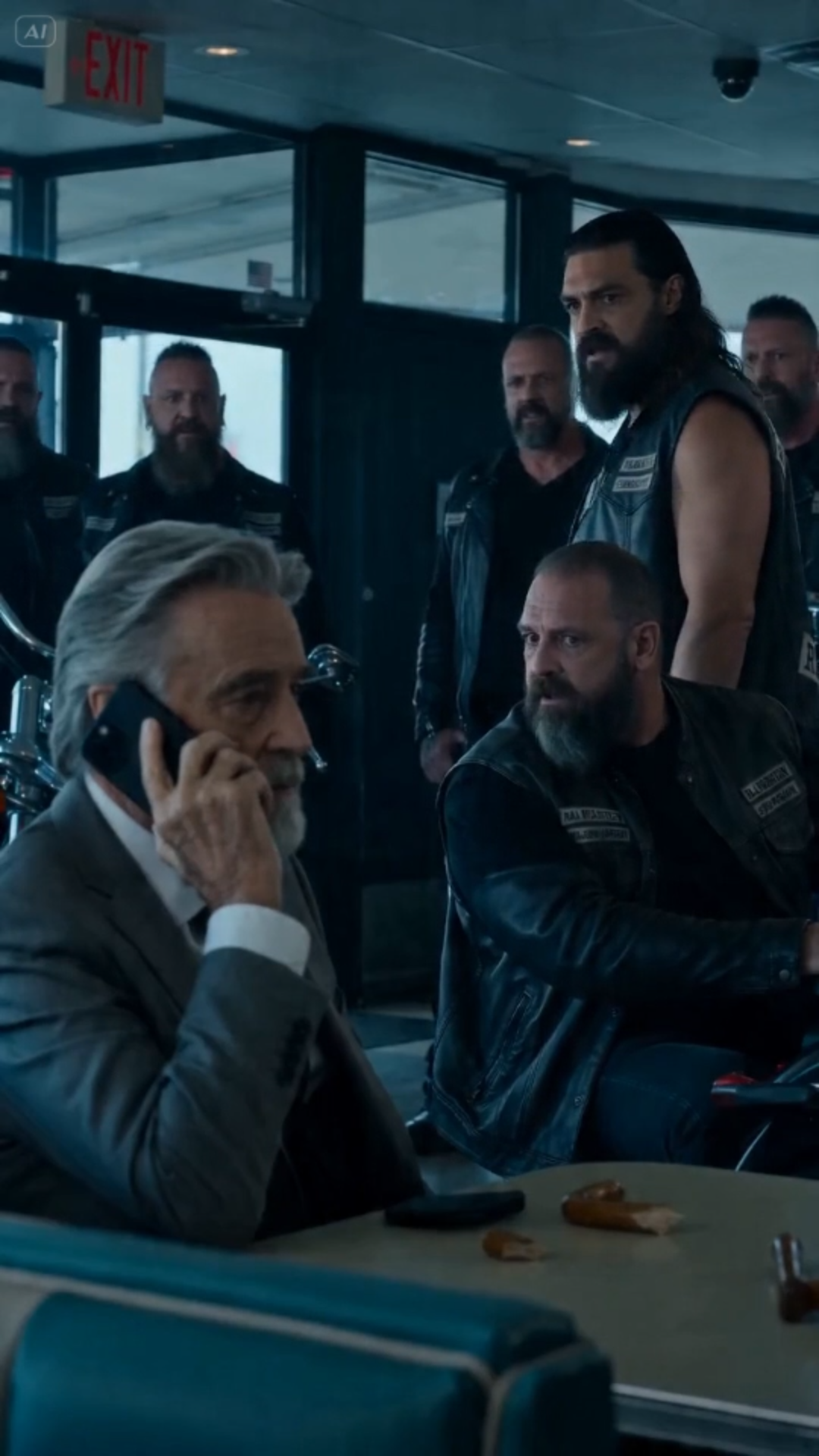
Walter Kane placed the wooden cane across his knees like it was the last fragile thing he owned.
It was not.
But Rex Dalton did not know that.
To Rex, the old man sitting alone by the window looked like an easy target.
Silver hair.
Silver beard.
Slim shoulders.
Elegant gray suit.
White shirt buttoned to the collar.
A wooden cane held in one quiet hand.
Walter looked expensive, but old.
Dignified, but breakable.
And Rex Dalton had built his whole life around breaking people who looked too weak to fight back.
The diner was almost empty that Tuesday afternoon.
Cold fluorescent lights buzzed above the teal booths.
Rain clouds pressed against the large front window.
The parking lot outside was gray, wet, and quiet.
Inside, the smell of coffee and fried onions hung in the air.
It should have felt familiar.
Safe.
American in the ordinary way.
But it did not.
Not anymore.
Not since Rex and his biker gang had started using the place like a private clubhouse.
They filled the back booths in black leather, boots stretched into the aisle, laughing too loudly, paying too little, and making every waitress walk around them like they were landmines.
The owner, Carol Briggs, stood behind the counter pretending not to watch.
She was fifty-eight, tired-eyed, and proud in the way people become when pride is the only thing they have left.
Her husband had built the diner thirty years ago.
Her daughter had worked there after school.
Her grandchildren still ate pancakes in the corner booth on Sundays.
Now Carol was three weeks from losing it.
Because Rex Dalton wanted the land.
Or at least, that was what everyone believed.
Walter knew better.
He had come to find out how far Rex would go.
He had also come to make sure Rex did it in public.
Rex noticed him after the third cup of coffee.
He looked over from the back booth, chewing slowly, eyes narrowing.
“Who’s the old suit?” he asked.
One of his men laughed.
“Maybe he’s lost.”
Another said, “Maybe he’s here to buy us lunch.”
Rex stood.
The diner changed instantly.
Carol stopped wiping the counter.
A young waitress froze near the coffee machine.
Two truckers near the door looked down at their plates.
Walter did not move.
Rex crossed the floor with a heavy, deliberate walk.
Long hair brushed his shoulders.
His beard was thick.
His black leather vest hung over a black T-shirt stretched across a large chest.
He stopped at Walter’s table and smiled.
It was not a friendly smile.
It was the kind of smile a man wore when he wanted everyone else to know the rules had just changed.
“You waiting for somebody, old man?”
Walter looked up.
His eyes were pale, calm, and colder than the window glass.
“Yes.”
Rex’s smile widened.
“Wrong answer.”
Walter said nothing.
Rex leaned closer.
“You know whose diner this is?”
Walter glanced at Carol.
“Not yours.”
The silence that followed was sharp.
One of Rex’s men muttered, “Oh, he’s got a mouth.”
Rex looked at the cane.
Then at Walter.
Then back at the cane.
“What’s this? Family heirloom?”
Walter’s hand tightened slightly.
“It belonged to my brother.”
Rex laughed.
“Then he had bad taste.”
Before Carol could speak, before anyone could move, Rex grabbed the cane from Walter’s hand.
He raised it high.
For one moment, the whole diner seemed to hold its breath.
Then Rex slammed the cane onto the tabletop.
Once.
Hard.
The crack was dry and brutal.
The cane split into two main pieces across the table.
One half rolled toward the sugar dispenser.
The other slid near the edge and stopped beside Walter’s coffee cup.
The sound was so loud the waitress flinched and dropped a spoon.
Rex grinned like a boy proud of a cruel trick.
Behind him, the biker gang erupted in laughter.
Walter flinched for only one brief second.
A blink.
A tightening of the jaw.
Then he went perfectly still.
He looked at the broken cane pieces on the table.
Not with fear.
Not even with anger.
With something worse.
Recognition.
As if Rex had just stepped exactly where Walter had expected him to step.
Rex leaned down.
“What are you gonna do now?”
Walter slowly lifted his eyes.
“Nothing yet.”
Rex frowned.
“Nothing yet?”
Walter’s voice was quiet.
“You’ll understand the word later.”
The laughter thinned.
Rex stared at him.
Then he turned away with a loud snort and walked back toward his men.
“Crazy old man,” he said.
The gang laughed again, but the sound was weaker now.
The two broken cane pieces remained on the table.
Walter did not touch them.
He did not ask Rex to pay for them.
He did not shout.
He reached into the inner pocket of his gray suit jacket and took out one phone.
Rex saw it from across the diner.
“What, old man?” he called, still smirking.
Walter pressed the phone to his ear.
His eyes never left Rex.
“It’s me,” he said. “Bring ’em.”
Then he lowered the phone, still holding it in his hand.
For a few seconds, Rex kept smiling.
Then three black SUVs came into the parking lot.
They arrived fast.
One after another.
Their tires hissed across the wet pavement.
Their headlights swept across the big diner window and washed the teal booths in cold white light.
The first SUV stopped directly in front of the door.
The second blocked the side exit.
The third parked near Rex’s motorcycles.
No sirens.
No shouting.
No weapons.
Just doors opening in perfect sequence.
The laughter died.
Men and women in dark coats stepped out.
A tall woman with cropped black hair.
A heavyset man carrying a leather case.
Two younger men holding cameras.
And finally, a white-haired Black man in a navy overcoat who looked at the diner as if he had buried something there and come back to dig it up.
Carol whispered, “Oh my God.”
Rex turned slowly toward Walter.
The old man still sat calmly, phone in hand.
The cane remained broken on the table.
Rex’s face tightened.
“Who the hell are they?”
Walter did not answer.
The front door opened.
The tall woman entered first.
She walked directly to Walter’s table, looked at the broken cane, then at Rex.
“Mr. Kane,” she said. “Do not touch the evidence.”
Rex barked a laugh.
“Evidence?”
The woman turned.
“I’m Assistant District Attorney Lauren Reeves.”
That shut up one of the bikers immediately.
The man in the navy overcoat stepped beside her.
Rex stared at him.
Something flickered across his face.
Not recognition.
Fear of recognition.
The man looked older now, but his eyes were still unmistakable.
Walter stood slowly from the booth.
“My brother,” he said, “Isaac Kane.”
Carol gasped.
Rex’s head snapped toward Walter.
“That’s not possible.”
Isaac looked at Rex without blinking.
“Your father said the same thing the night he left me in the quarry.”
The diner went silent.
Even the rain seemed to pause against the glass.
Rex’s mouth opened.
Nothing came out.
Walter looked at Carol.
Then at the truckers.
Then at the frightened waitress near the coffee machine.
“This town was told my brother died in a motorcycle crash twenty-seven years ago,” Walter said.
Isaac’s face remained hard.
“That was the story Rex’s father paid men to repeat.”
Rex’s voice came out rough.
“You don’t know what you’re talking about.”
Walter picked up the phone slightly.
“I know more than you hoped I would.”
Lauren Reeves opened the leather case on the table.
Inside were photographs.
Old police reports.
Bank records.
Property deeds.
And one yellowed picture of two young men standing in front of the diner with matching work jackets.
Walter Kane and Isaac Kane.
The diner had been theirs once.
Before Carol’s husband bought it.
Before Rex’s father began using biker intimidation to force property owners into selling.
Before Isaac discovered the scheme.
Before he disappeared.
Walter looked at Rex.
“Your father wanted this land. He wanted the highway access. He wanted every business on this strip pushed out so he could sell the whole corridor to developers.”
Rex swallowed.
“My father’s dead.”
“Yes,” Walter said. “But his company isn’t.”
Lauren placed a document on the table.
“And neither are the shell accounts he left behind.”
Rex tried to laugh, but it sounded wrong.
“You’re blaming me for old business?”
Isaac stepped forward.
“No. We’re blaming you for continuing it.”
Lauren nodded to one of the men with cameras.
He turned a small screen toward the room.
On it was footage from outside the diner.
Rex’s men spray-painting Carol’s back door.
Rex taking an envelope of cash from her counter.
Rex telling a delivery driver that accidents happened to people who kept bringing food to places that should have closed already.
Carol covered her mouth and began to cry.
Rex glared at her.
“You recorded me?”
Walter answered.
“No. She survived you.”
Lauren placed another folder on the table.
“Carol Briggs contacted the Kane Family Justice Office six weeks ago. She believed she was only reporting harassment. She did not know her diner was tied to a twenty-seven-year-old attempted murder investigation.”
Rex’s face went pale.
The bikers behind him shifted uncomfortably.
One of them whispered, “Attempted murder?”
Isaac unbuttoned his overcoat.
Underneath, his left shoulder sat lower than the right.
His hand trembled slightly at his side.
“When Rex’s father found out I had copied the land records, he and two men followed me after closing,” Isaac said. “They beat me. They drove me to the old quarry. They left my bike at the bend in the road and pushed me over the edge.”
Carol sobbed quietly.
“I woke up three days later in a county hospital under the wrong name,” Isaac continued. “No memory. No wallet. No brother beside me because nobody told Walter I was alive.”
Walter’s face tightened.
For the first time, his calm almost cracked.
“I buried an empty casket,” he said.
The sentence filled the diner with a kind of grief Rex could not bully away.
Walter looked at the broken cane.
“That cane belonged to Isaac. He carved it himself after the fall, when he was learning to walk again.”
Rex glanced at the two pieces.
For the first time, he seemed to understand he had not broken a stick.
He had broken history.
Isaac smiled without warmth.
“And when I finally remembered my name, I remembered one more thing.”
Lauren picked up one piece of the broken cane carefully with gloved hands.
Inside the split wood, something small glinted.
A narrow metal tube.
The diner froze.
Walter looked at Rex.
“My brother hid the original land-transfer ledger inside the cane before your father caught him.”
Rex staggered half a step back.
“No.”
Lauren removed the tube, opened it, and slid out a tightly rolled strip of old microfilm sealed in plastic.
“Thank you, Mr. Dalton,” she said coldly. “We knew the cane contained evidence. We needed chain of custody and probable cause. You just broke it open in front of twelve witnesses.”
One of Rex’s bikers stood.
“I didn’t sign up for this.”
Rex spun around.
“Sit down.”
But nobody obeyed fast enough.
The power in the room had shifted.
Rex was still big.
Still loud.
Still dangerous-looking.
But he was no longer the storm.
He was the man caught in it.
Two county deputies entered from the doorway.
Behind them came a federal investigator.
No guns drawn.
No violence.
Just quiet authority.
Lauren faced Rex.
“Rex Dalton, you are being detained in connection with extortion, witness intimidation, property fraud, and conspiracy related to the attempted murder of Isaac Kane.”
Rex’s voice rose.
“My father did that!”
Walter’s eyes narrowed.
“And you profited from it.”
Lauren added, “You also threatened Carol Briggs last Tuesday, demanded cash payments, and signed transfer documents through a shell company connected to your dealership.”
Rex looked toward his men.
“Say something!”
No one did.
Not the bikers.
Not the truckers.
Not Carol.
Not the waitress.
For years, Rex had mistaken silence for loyalty.
Now he learned it had only been fear.
And fear changes owners quickly.
As the deputies led him outside, Rex twisted back toward Walter.
“You planned this.”
Walter looked at the broken cane pieces on the table.
“Yes.”
Rex’s face twisted with rage.
Walter’s voice stayed calm.
“You taught people to be afraid when you walked into a room. I wanted them to see what happened when you finally walked into mine.”
Rex was put into the back of a county SUV.
Then two of his men were separated and questioned.
By sundown, one had already started talking.
By the next week, the case had widened beyond Rex Dalton.
The old microfilm showed forged property transfers from the original highway expansion project.
Isaac’s hidden ledger connected Rex’s father to three county officials, two fake notaries, and a development company that had quietly acquired land through threats for almost three decades.
Some of the men were dead.
Some were retired.
Some had built respectable lives on stolen ground.
None of them stayed respectable for long.
The story hit the local news first.
Then Nashville.
Then national outlets.
Old Man’s Broken Cane Reopens Decades-Old Land Fraud Case.
But Walter refused interviews.
Isaac gave only one statement.
“I did not come back for revenge. I came back because my brother deserved the truth.”
Carol got her diner back free and clear.
The court voided the fraudulent pressure contracts.
A restitution fund was created for families who had been forced off their land.
Rex Dalton was convicted of extortion, fraud, witness intimidation, and conspiracy.
His father’s old company was dissolved.
Its assets were liquidated.
Part of the money rebuilt the businesses Rex had terrorized.
Part of it funded a legal clinic for people facing predatory land deals.
Walter and Isaac named it The Broken Cane Project.
Carol insisted the first office be built beside the diner.
Six months later, the diner reopened after renovations.
Same teal booths.
Same big window.
Same cold fluorescent lights, though Carol replaced half of them with warmer bulbs because, as she said, “People have had enough cold in here.”
The broken cane pieces were placed in a glass case near the register.
Not repaired.
Not hidden.
Two clean pieces of old wood, displayed exactly as Rex had left them.
Below them was a brass plaque.
Some things have to break before the truth can get out.
Walter sat in the same booth on opening day.
This time Isaac sat across from him.
Two old brothers.
One alive after being buried by a lie.
One whole again after years of grief.
Carol brought them coffee.
On the house.
Forever, she said.
Walter looked out the window at the parking lot.
No black SUVs.
No bikers.
No fear.
Just families coming in for breakfast.
Truckers shaking hands.
A young waitress laughing near the coffee machine.
A small boy pointing at the cane case and asking his mother what happened.
Isaac heard him and smiled.
“Should we tell him?” he asked.
Walter took a slow sip of coffee.
“Not yet.”
Isaac chuckled.
Walter looked at the two broken pieces in the glass case.
For twenty-seven years, he had thought the worst sound of his life was dirt hitting his brother’s empty coffin.
He had been wrong.
The sound that changed everything was a cane cracking in half on a diner table.
A cruel sound.
A public sound.
A sound Rex Dalton made because he believed an old man was powerless.
But that was the thing about bullies.
They never understood the difference between weakness and patience.
Rex saw a cane and thought it was support.
Walter saw a cane and knew it was testimony.
Outside, sunlight broke through the clouds and filled the parking lot.
Inside, the diner doors opened again and again.
Nobody lowered their eyes.
Nobody hurried through breakfast.
Nobody left cash in envelopes under the register.
Walter leaned back in the booth, his phone resting beside his coffee cup.
Isaac looked at him.
“You think Ruth would’ve liked this?”
Walter looked at the diner.
At Carol.
At the families.
At the broken cane behind glass.
Then he nodded.
“She always said the truth didn’t need to shout.”
Isaac smiled.