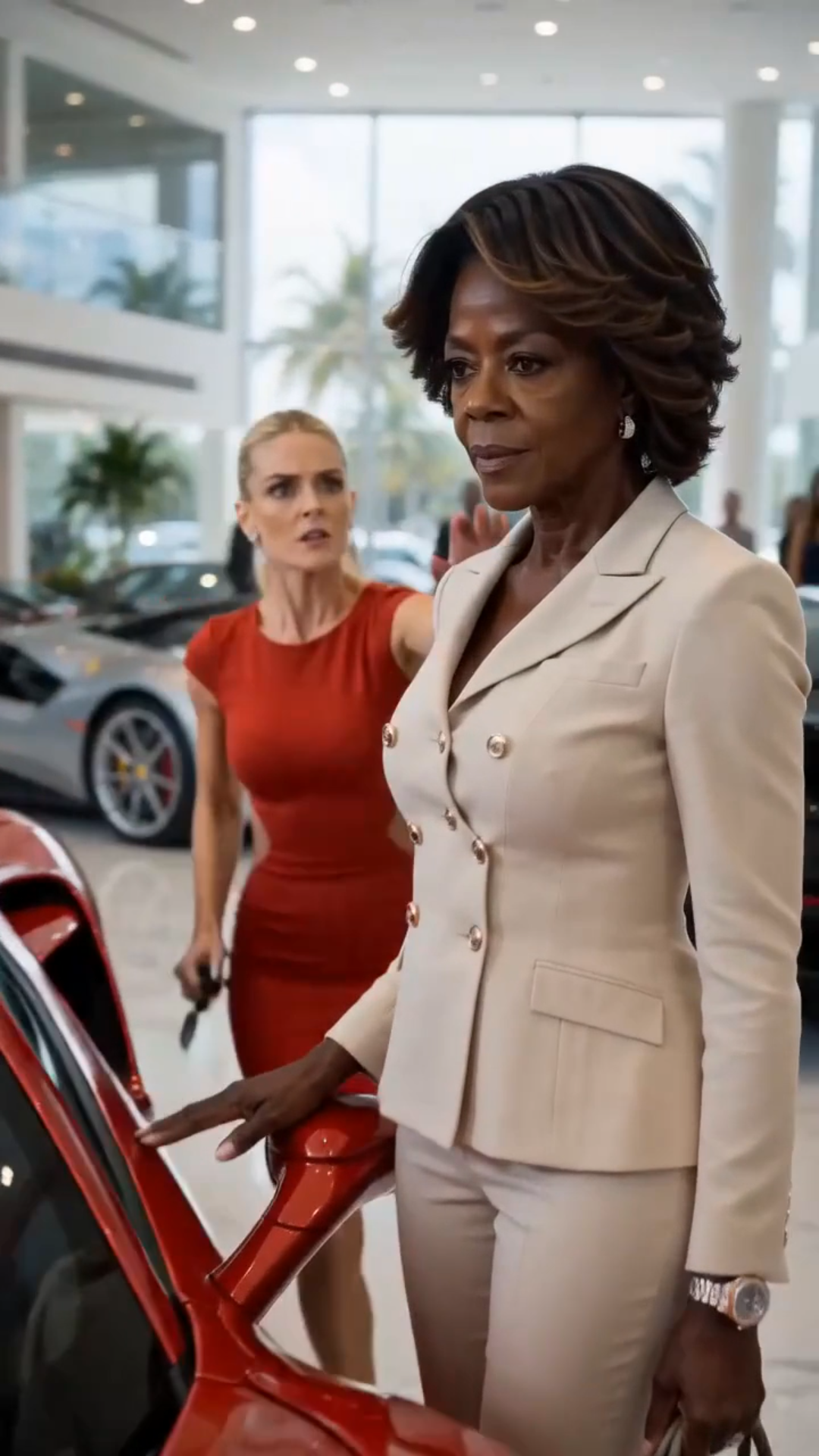
Monica Hayes had not come to the dealership to buy a car.
That was the first thing Ava Sinclair failed to understand.
The second was that Monica had already bought something far more important.
The luxury showroom on Biscayne Boulevard looked like it had been designed for people who believed sunlight belonged to them. Glass walls stretched from marble floor to ceiling, framing palm trees, blue Miami sky, and the slow glitter of traffic outside. Inside, polished chrome, champagne-gold fixtures, and carbon-black display platforms made every car look like a sculpture waiting for applause.
At the center of the room sat a red Ferrari.
Low, bright, immaculate.
The kind of car that made wealthy men lower their voices and young employees stand a little straighter.
Monica stood beside it in a cream tailored pantsuit, one hand resting lightly on her designer handbag, her luxury watch catching the showroom light. She was fifty-four, with deep brown skin, short natural curls, and eyes that had learned long ago not to flinch just because someone expected her to.
She looked calm.
Almost too calm.
A salesman had asked if she needed help when she first entered. His smile had faded when she told him she was only looking. Then he had drifted toward a younger couple taking selfies beside a Lamborghini in the back.
That was fine.
Monica preferred to be ignored at first.
People revealed more that way.
She walked slowly around the Ferrari, studying the paint, the tires, the stitching visible through the glass, the dealership’s floor behavior, the way staff watched some customers and welcomed others. Every detail mattered.
A slim red key rested on the display stand.
Monica picked it up.
Not because she needed permission.
Because it was hers to pick up.
That was when Ava Sinclair saw her.
Ava was twenty-nine, dressed in a tight red designer dress that matched the car too perfectly to be accidental. Her blonde ponytail was sleek, her diamond earrings flashed under the lights, and she walked across the marble like someone arriving late to a room that had been waiting for her.
Two customers moved aside without being asked.
A sales associate whispered, “Ms. Sinclair,” as if the name itself required careful handling.
Ava’s eyes locked on the key in Monica’s hand.
Her smile disappeared.
“Excuse me,” she said sharply.
Monica turned.
Ava looked her up and down once, taking in the cream pantsuit, the handbag, the quiet confidence she could not immediately categorize.
Then Ava’s gaze dropped to the key.
“Put that down.”
Monica’s expression did not change.
“Is there a problem?”
Ava laughed once, cold and bright.
“Yes. You’re touching my car.”
A few people nearby turned.
The showroom did not stop, but it slowed. A man in linen pants paused near the espresso bar. A receptionist at the front desk lifted her head. Two sales associates exchanged quick looks and then pretended they had not.
Monica glanced at the Ferrari.
“Your car?”
“Yes,” Ava said. “The one you’re standing beside.”
Monica turned the key once in her hand.
“Interesting.”
That word irritated Ava more than any insult could have.
She stepped closer.
“I don’t know who told you that you could wander in here and play rich for the afternoon, but this is a private delivery vehicle.”
Monica looked toward the manager’s office, a glass-walled room raised slightly above the showroom floor.
Inside stood the general manager, Harold Pierce, a fifty-year-old man in a dark charcoal suit and expensive tie. He watched the exchange with a controlled corporate expression.
He did not come out.
Monica noticed.
Ava noticed too, but for a different reason.
Harold’s silence made her bolder.
“Do you work here?” Ava asked.
“No.”
“Then why are you touching inventory?”
“Because I wanted to see how carefully it was being handled.”
Ava smiled like she had caught something.
“You wanted to see?” She turned slightly toward the watching staff. “Do we let anyone just inspect cars now?”
A salesman gave an uncomfortable laugh.
Monica said nothing.
Her silence made the room more tense.
Ava moved closer again, invading the space between them.
“I know your type,” she said softly. “You walk into places like this hoping nobody asks too many questions.”
Monica’s eyes cooled.
“My type?”
Ava’s smile sharpened.
“The kind who makes everyone uncomfortable and then acts offended when people notice.”
The receptionist looked down.
A young mechanic near the service corridor stiffened.
Monica saw his reaction.
She saw everything.
Years earlier, before she owned board seats and private equity shares and homes with ocean views, Monica had worked reception at a dealership in Atlanta while raising her son. She knew the smell of polished floors and fake respect. She knew which customers got coffee before they asked and which ones got followed with friendly suspicion.
She had promised herself, after leaving that job with a final paycheck and a thousand quiet humiliations, that one day she would own rooms where people like Ava Sinclair could no longer decide who belonged.
That day had taken thirty years.
Ava reached out and grabbed Monica’s shoulder.
Hard.
Monica turned only because Ava forced the movement.
The slap came fast.
Sharp.
Loud enough to cut through the glassy showroom music.
Monica’s face turned with the impact.
The Ferrari key slipped from her fingers and hit the marble floor with a metallic crack.
Every person in the showroom froze.
One woman gasped.
A salesman whispered, “Oh my God.”
The mechanic stepped forward, but Monica lifted one hand slightly.
Stop.
She turned back slowly.
Her cheek stung.
Her eyes did not.
Ava stood in front of her, breathing hard, furious and triumphant.
“Touch my car again,” she said, “and you’re out.”
The room waited for Monica to shout.
To cry.
To demand security.
To defend herself.
Instead, Monica looked down at the key on the marble floor.
Then she looked at Harold Pierce behind the glass wall.
He still had not moved.
That told her the final thing she needed to know.
Monica reached into her handbag and removed one smartphone.
Ava scoffed.
“What, are you calling someone?”
“Yes,” Monica said.
Her voice was calm enough to make several employees look up.
She dialed.
The call connected almost immediately.
“Lock every inventory account,” Monica said.
Harold’s head snapped up inside the office.
Ava’s smile flickered.
Monica continued.
“Suspend operations now.”
She ended the call and kept the phone in her right hand.
For three seconds, nothing happened.
Then phones started vibrating.
Not one.
Several.
At the reception desk.
In the sales pit.
Inside the manager’s office.
A salesman looked down at his screen and went pale.
The receptionist covered her mouth.
Harold Pierce rushed out of the office so quickly his polished composure barely had time to follow him.
“Ms. Hayes,” he said.
The title moved through the showroom like a cold wind.
Ava frowned.
“Ms. who?”
Harold stopped in front of Monica, breath tight, face draining of color.
“Please wait,” he said. “There must be some misunderstanding.”
Monica’s eyes stayed on him.
“There was a misunderstanding when your staff ignored three customer complaints last month.”
Harold swallowed.
“There were internal reviews—”
“There was no review.”
His mouth closed.
Ava looked between them, suddenly less certain.
“What is going on?”
Harold did not answer her.
Monica took one step toward him.
“Pick up the key.”
Harold hesitated.
Then he bent down and picked up the red key from the marble floor.
He held it out to her with both hands.
Not because he was polite.
Because he was afraid.
Ava stared at the gesture.
“Harold,” she snapped, “why are you handing her my key?”
Monica accepted it.
“It was never your key.”
Ava laughed, but it came out wrong.
“My father has a standing account here.”
“Your father has a preferred client profile,” Monica said. “Not ownership.”
Harold’s voice came out barely above a whisper.
“Ma’am…”
Monica turned her head slightly.
He lowered his gaze.
“You own this company.”
The showroom went silent.
Not quiet.
Silent.
Ava’s face changed in stages.
Confusion first.
Then disbelief.
Then humiliation.
Finally, fear.
Monica looked at her.
“No,” Ava said. “That’s impossible.”
Monica slipped the Ferrari key into her palm.
“What part?”
“You can’t just—”
“Own the place you thought you could throw me out of?”
Ava’s lips parted, but no words came.
Monica turned away from her and faced the staff.
“My name is Monica Hayes. As of this morning, Hayes Meridian Group holds majority ownership of Royale Miami Motors and its connected dealership network.”
People stared at her as if the room itself had been rearranged.
“Today was supposed to be a quiet operational visit,” Monica continued. “No press. No cameras. No formal introduction. I wanted to see how this showroom treated people when it did not know who was watching.”
Her eyes moved to Harold.
“Now I know.”
Harold tried to recover.
“Ms. Hayes, Ms. Sinclair is a long-standing client. This situation escalated unexpectedly.”
Monica looked at him.
“A woman was assaulted in your showroom while you watched from behind glass.”
Harold flinched.
Ava snapped, “Assaulted? I slapped her because she touched my delivery car.”
The mechanic spoke before anyone else could.
“It wasn’t her delivery car.”
Every head turned toward him.
He was young, maybe twenty-six, wearing a black service shirt with grease near one cuff. His name tag read Luis.
Ava glared.
“Excuse me?”
Luis looked nervous, but he kept going.
“That Ferrari was pulled from secured inventory this morning. Ms. Sinclair asked to pose with it. She told Brian to put the key out for photos.”
Ava’s eyes widened.
“Shut up.”
Monica looked at Luis.
“Who authorized that?”
Luis looked at Harold.
Harold’s face tightened.
Monica did not need more.
But she let the silence work.
A receptionist raised her hand slightly.
“Ms. Hayes?”
“Yes.”
“Ava comes in all the time. Staff get told to let her use cars for content because her father brings clients.”
A salesman near the espresso bar added, “We’ve had complaints. People who came in dressed casual, people with older cars, people who didn’t look like big buyers. They get pushed off the floor or handed to junior staff.”
Another employee said, “Harold told us not to waste time on ‘unlikely buyers.’”
Harold’s composure cracked.
“That is being taken out of context.”
Monica looked at him.
“Then put it back in context.”
He had no answer.
The showroom remained frozen around them.
Outside the glass walls, palm trees shifted in the Miami breeze. Inside, Ava Sinclair stood beside a car she did not own, in a room that had stopped obeying her.
Monica looked at her directly.
“You put your hands on me because you believed status would protect you.”
Ava’s jaw tightened.
“You don’t understand who my father is.”
Monica almost smiled.
“I know exactly who your father is.”
That was when Ava truly went still.
Monica turned to Harold.
“Call Mr. Sinclair.”
Harold blinked.
“Now?”
“Now.”
His hand shook as he dialed.
The call connected on speaker because Monica told him to place it on the counter.
A man’s voice filled the air.
“Harold? I’m in a meeting.”
“Mr. Sinclair,” Harold said weakly, “Ms. Hayes is here.”
A pause.
Then the man’s voice changed.
“Monica Hayes?”
Ava stared at the phone.
Monica stepped closer.
“Good afternoon, Robert.”
Another pause.
Then Robert Sinclair spoke with careful respect.
“I wasn’t aware you were visiting today.”
“That was the point.”
Ava’s face lost color.
“Dad?”
Robert’s voice sharpened.
“Ava? Why are you there?”
Ava opened her mouth, but Monica answered.
“Your daughter struck me in the showroom after claiming ownership of inventory she was allowed to use for personal image purposes.”
The silence on the phone was worse than shouting.
“Ava,” Robert said slowly, “tell me she is mistaken.”
Ava’s eyes filled with embarrassed anger.
“She was touching the car.”
Robert exhaled.
“Oh, Ava.”
That small disappointment hurt her more than Monica expected.
For the first time, Ava looked less like a villain and more like a person whose whole life had trained her badly.
Monica did not soften.
Training did not erase harm.
Robert continued. “Ms. Hayes, I apologize. Completely. I will address this.”
“You will,” Monica said. “But not through a quiet family conversation.”
Ava looked up.
Monica’s voice stayed steady.
“Your preferred client privileges are suspended pending review. Any informal showroom access granted to your family ends today. Harold Pierce is suspended from operational authority immediately. Inventory accounts remain locked until an audit confirms no vehicles were used, moved, or represented without authorization.”
Harold whispered, “Ms. Hayes, please.”
Monica looked at him.
“You had months to fix the culture in this room before I walked into it.”
His shoulders sank.
Ava glanced around and realized no one was stepping forward to rescue her.
No father.
No manager.
No salesman eager to laugh along.
The room had changed sides not because Monica was powerful, but because Monica had made it safe to stop pretending.
That was the deeper reversal.
Monica turned to Luis.
“Who is the senior-most operations lead on site after Harold?”
Luis pointed toward the service corridor.
“Dana Park. She runs back-end delivery and compliance.”
“Bring her.”
Dana Park arrived two minutes later in a plain black blazer, carrying a tablet, looking stunned and terrified.
Monica asked one question.
“Have you filed complaints about front-floor conduct?”
Dana looked at Harold.
Then at Monica.
“Yes.”
“How many?”
“Seven.”
“Where did they go?”
Dana’s voice hardened.
“To Harold.”
Monica nodded.
“Congratulations. You are interim general manager.”
Harold looked like the marble floor had vanished beneath him.
Dana froze.
“Ma’am?”
“Temporary appointment pending formal review. If you don’t want it, say so.”
Dana swallowed.
“I want it.”
“Good. Start by reopening operations for scheduled deliveries only. No walk-in sales until staff briefing. No influencer access. No unofficial key handling. No exceptions.”
Dana straightened.
“Yes, Ms. Hayes.”
Ava laughed bitterly.
“So that’s it? I’m just supposed to be humiliated?”
Monica turned back to her.
“You humiliated yourself. I only refused to carry it for you.”
Ava’s face tightened, then crumpled for one dangerous second before she rebuilt it into pride.
“I’m leaving.”
“Yes,” Monica said. “You are.”
Ava walked toward the glass doors, heels sharp against marble. Nobody stopped her. Nobody apologized to her. Nobody gave her the comforting performance of pretending she had been misunderstood.
At the door, she turned back once.
Monica stood beside the red Ferrari, phone in hand, cream suit untouched except for the faint mark on her cheek.
The room belonged to her now.
But she did not look triumphant.
That unsettled Ava more than anything.
After Ava left, Monica asked everyone to gather near the center aisle.
Some employees looked afraid. Others looked relieved.
Monica waited until the showroom settled.
“I am not here to punish an entire staff for what leadership allowed,” she said. “But understand this clearly. Luxury does not mean exclusion. It means excellence. If a person walks into this showroom, you will not decide their worth by clothing, accent, age, race, car, or confidence.”
Luis lowered his eyes.
Monica continued.
“My father sold used cars from a gravel lot outside Savannah. He treated every customer like they had worked hard for the money in their pocket, whether they came in with cash, credit, or questions. When he died, I kept his first set of keys.”
She opened her handbag and removed a small old key ring.
Three dull keys hung from it.
Nothing like the Ferrari key.
“Those keys taught me more about this business than any boardroom.”
The receptionist wiped her eyes.
Monica looked around the showroom.
“This place forgot what selling cars really means. It is not worshiping machines. It is respecting people at the moment they decide to trust you with a dream.”
The audit that followed lasted six weeks.
It found exactly what Monica suspected.
Unauthorized vehicle usage for social media appearances. Preferential access granted to wealthy clients’ families. Complaints buried. Sales leads dismissed based on appearance. Service customers overcharged when staff assumed they would not challenge invoices.
Harold Pierce resigned before termination became official.
Dana Park became permanent general manager.
Luis was promoted to customer experience supervisor after Monica learned he had been quietly helping dismissed customers get proper appointments through the service entrance.
Ava Sinclair disappeared from the showroom circuit for a while. Her father issued a private apology, then a public one after several former customers came forward with similar stories about being dismissed at luxury businesses where his family held influence.
Monica did not press charges over the slap.
Not because she forgot.
Because she had chosen a different consequence.
Ava was required, through her father’s client agreement settlement, to fund a scholarship for women entering automotive sales and management programs in South Florida. Her name did not go on it. Monica insisted on that.
“No reputation laundering,” she said.
Three months later, Royale Miami Motors looked almost the same from the street.
Glass walls.
White marble.
Palm trees.
Red Ferrari under lights.
But inside, the room had changed.
A retired schoolteacher in sneakers was offered espresso before he asked.
A young woman in scrubs was invited to sit in the driver’s seat of a Porsche she had saved years to test.
A delivery driver dropping off lunch was not followed through the showroom.
The key stands stayed locked.
And near the employee entrance, a framed photograph appeared.
It showed a younger Monica standing beside her father on a gravel lot in Georgia, both of them leaning against a faded sedan with a paper price tag on the windshield.
Under the photograph were the words:
Every customer walks in carrying a story. Respect it before you try to sell them anything.
One afternoon, Monica returned unannounced.
This time, Dana saw her first and smiled.
“No inventory lockdown today, I hope.”
“That depends,” Monica said.
Dana laughed nervously.
Monica walked to the center of the showroom and stopped beside the same red Ferrari.
The marble still reflected its paint.
The lights still made it look impossible.
Luis approached with a careful smile.
“Would you like the key, Ms. Hayes?”
Monica looked at the car.
Then at the showroom.
Then at the staff greeting customers without measuring them first.
“Yes,” she said. “But not for me.”
Outside, through the glass, a teenager stood with his mother near the entrance. He wore a fast-food uniform and stared at the Ferrari like it was a spaceship. His mother tugged his sleeve, embarrassed, ready to leave before anyone made them feel out of place.
Monica saw the look.
She had worn it once.
She nodded toward them.
“Ask if he wants to sit in it.”
Luis smiled.
“Yes, ma’am.”
The teenager’s face lit up when Luis opened the door.
His mother covered her mouth.
Monica stood a few steps away, watching quietly.
Months earlier, Ava Sinclair had slapped her in that same room for touching a car she did not own.
Now a boy who could not afford anything in the building sat behind the wheel of a dream, treated with more dignity than any price tag could measure.
Dana came to stand beside Monica.
“Do you ever get tired of teaching people lessons?” she asked.
Monica smiled faintly.
“I’m not teaching lessons.”
“What are you doing?”