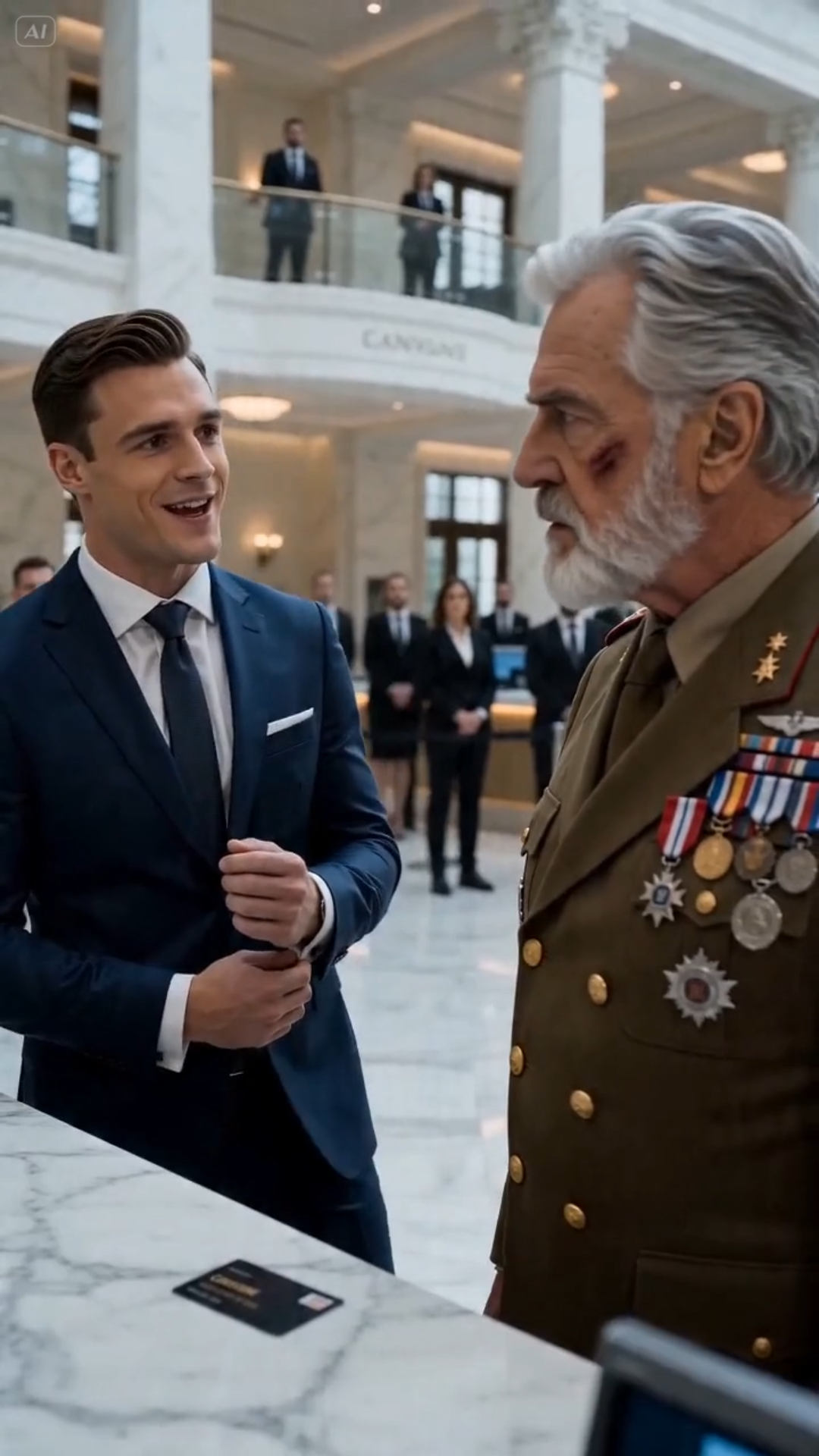
Arthur Hayes had stood in worse rooms than this one.
Rooms filled with smoke.
Rooms filled with blood.
Rooms where men begged for their mothers while helicopters shook the sky.
So the lobby of Sterling Crown Private Bank did not intimidate him.
Not the white marble floors.
Not the glass ceiling pouring soft daylight over polished counters.
Not the silent customers in tailored coats.
Not the young bankers who looked at his uniform and saw a costume before they saw a man.
Arthur stood at the main teller counter with his black bank card under his palm.
He was seventy-one.
Silver hair.
White beard.
A large scar cut down his left cheek, pale against weathered skin.
His olive-khaki military uniform was formal and immaculate.
Medals covered his chest.
None of the text on them mattered to the people staring.
They saw age first.
Then the scar.
Then the uniform.
Then made their decision.
He did not belong.
The first teller had already ignored him twice.
A young woman with perfect nails and a polite smile kept saying, “Someone will be with you shortly,” while helping three younger customers who arrived after him.
Arthur waited.
Five minutes.
Ten.
Then fifteen.
He watched the bank carefully.
The marble.
The cameras.
The security guard pretending not to notice.
The manager’s office with frosted glass walls.
The employees who saw an old soldier standing alone and somehow decided patience was the same as permission.
Finally, Arthur placed the black card on the counter.
Then he slammed his hand down beside it.
The sound cracked through the lobby.
The teller flinched.
A customer near the ATM turned.
Arthur’s voice was low, but it carried.
“I said check my balance. Don’t ignore me.”
The teller’s face went pale.
Before she could answer, Caleb Stone walked over from the private-client area.
He was thirty-two.
Navy suit.
White shirt.
Dark tie.
Gel-styled hair.
Expensive watch.
Polished shoes that had never stood in mud unless it was decorative.
He moved with the smooth confidence of someone promoted too early by people impressed with their own reflection.
“Is there a problem here?” Caleb asked.
Arthur slowly turned his head.
“Yes.”
Caleb looked him up and down.
The medals.
The scar.
The old hands.
The black card.
His mouth curved.
Not enough to be called a smile.
Enough to be insult.
“Sir,” Caleb said, “this is a high-tier bank. Maybe you’re in the wrong place.”
The lobby became quieter.
Nobody wanted to be involved.
But everyone wanted to watch.
Arthur’s eyes locked on Caleb’s face.
For one second, Caleb stopped breathing.
He did not understand why.
Something in the old man’s stare made the marble lobby feel smaller.
Arthur said, “No.”
A pause.
“I think you’re the one in the wrong place.”
Caleb recovered with a laugh.
A soft one.
Practiced.
The kind used in boardrooms when someone poor says something true.
“Let’s settle this quickly.”
He took the black card from the counter between two fingers.
Like he expected it to fail.
Like the card itself had offended him.
Arthur did not move.
Caleb turned to the computer screen.
He swiped the card.
Typed.
Paused.
Typed again.
The screen glowed.
No readable numbers showed to the people watching.
Only the light reflected on Caleb’s face.
At first, he looked amused.
Then focused.
Then confused.
His eyebrows pulled together.
He leaned closer.
Behind him, Mark Ellis, another young banker in a black suit and tie, stepped over to see what was taking so long.
Mark glanced at the screen.
Then froze.
His mouth opened slightly.
His eyes widened.
Caleb looked at him.
“What?”
Mark did not answer.
He looked back at the screen as if the bank’s entire marble floor had just vanished under his shoes.
Caleb swallowed.
“What is this?”
Mark’s voice came out thin.
“Sir…”
He looked at Arthur.
Then back at Caleb.
“This account controls the parent company.”
The lobby went silent.
Not quieter.
Silent.
The teller stepped back from the counter.
The security guard straightened.
A woman near the ATMs lowered her phone slowly.
Caleb looked at the black card in his hand.
Then at Arthur.
Then back at the screen.
His polished face lost color.
Arthur stepped closer to the counter.
“Now,” he said.
“Are you still laughing?”
Caleb could not speak.
That was the first time Arthur saw the real man beneath the suit.
Not arrogant.
Not polished.
Afraid.
Arthur reached across the marble and took the black card from Caleb’s fingers.
Caleb let him.
The old soldier placed the card flat on the counter.
Then he turned toward Mark.
“Call your regional president.”
Mark blinked.
“Sir?”
Arthur’s voice sharpened.
“Now.”
Mark moved.
Fast.
Caleb finally found his voice.
“Mr. Hayes, I apologize if there was some misunderstanding.”
Arthur looked at him.
“No.”
The word cut clean.
“A misunderstanding is when two people hear different things.”
He looked around the lobby.
“This was a decision.”
Caleb’s jaw tightened.
“I didn’t know who you were.”
Arthur nodded once.
“That is exactly the problem.”
The words landed hard enough to make Caleb look down.
Arthur turned back to the computer screen.
“Print the access log for the Veterans Continuity Trust.”
Mark stopped dialing.
His face changed again.
“How do you know that name?”
Arthur looked at him.
“I created it.”
A murmur moved through the lobby.
Caleb frowned.
“The Veterans Continuity Trust is under Sterling Crown Institutional Holdings.”
Arthur’s eyes stayed cold.
“No. Sterling Crown services it.”
He tapped the black card.
“I own the controlling interest through the Hayes Foundation.”
The teller whispered, “Oh my God.”
Arthur heard her.
He ignored it.
Thirty years earlier, Arthur Hayes had not cared about banks.
He cared about soldiers.
The kind who came home with missing legs.
The kind who did not come home at all.
The kind whose widows sat in government offices holding folded flags while clerks explained delays in careful voices.
Arthur had been a colonel then.
Younger.
Harder.
Already scarred.
He had watched a sergeant’s wife sell her car because survivor benefits took too long to process.
He had watched a wounded captain lose his house while banks “reviewed documentation.”
After the war, Arthur invested everything he had into a foundation designed to do one thing.
Move money fast when military families could not wait.
Emergency housing.
Funeral support.
Medical transport.
Education grants.
Legal assistance.
The Veterans Continuity Trust became his answer to delay.
Sterling Crown had been chosen as the servicing bank because, back then, its founder had a son in uniform and a conscience that still functioned.
But founders died.
Boards changed.
Banks got cleaner floors and dirtier habits.
Six months ago, Arthur began receiving letters.
Not formal complaints.
Letters.
From widows.
From veterans.
From adult children of fallen soldiers.
Accounts frozen for “verification.”
Emergency payments delayed.
Fees charged to hardship funds.
Customer service calls ignored.
One widow wrote:
They made me feel like I was begging for money my husband died earning.
Arthur read that sentence twelve times.
Then he stopped calling executives.
He came himself.
In uniform.
With the scar.
With the medals.
With the black card.
To see what the bank did when it thought no one important was standing there.
Now he knew.
The glass doors at the front opened.
A woman in a charcoal suit entered with two men behind her.
The lobby parted without being told.
Her name was Patricia Lowell.
President of Sterling Crown North America.
She had silver-blonde hair, sharp eyes, and the kind of authority that did not need volume.
She came straight to Arthur.
“General Hayes.”
Caleb looked like he had been struck.
General.
The word moved through the bank like electricity.
Patricia looked at the waterless calm in Arthur’s face.
Then at Caleb.
“What happened?”
Arthur answered before Caleb could.
“Your employee decided I was in the wrong bank.”
Patricia’s expression did not change.
That made Caleb more afraid.
She turned to Mark.
“Pull the lobby recording.”
Mark nodded quickly.
Arthur added, “And the service records for the Veterans Continuity Trust.”
Patricia’s eyes flicked to him.
“All of them?”
Arthur said, “Start with delayed hardship disbursements. Last eighteen months.”
Caleb’s face tightened.
Patricia noticed.
So did Arthur.
“Mr. Stone,” Arthur said.
Caleb swallowed.
“Yes, sir?”
“Why did that make you nervous?”
“It didn’t.”
Arthur’s eyes narrowed.
Caleb looked away too late.
Patricia turned to one of the men behind her.
“Get compliance on-site.”
The man left immediately.
Caleb raised both hands.
“With respect, this is becoming excessive. I made a judgment error at the counter.”
Arthur looked at him for a long time.
“You charged fees on emergency widow payments.”
Caleb’s face went blank.
Patricia turned slowly.
“Excuse me?”
Arthur reached into the inside pocket of his uniform jacket and removed a folded envelope.
He placed it on the counter.
Inside were printed letters.
Screenshots.
Account notes.
Internal complaint numbers.
A memo from an anonymous employee.
Arthur slid one page across the marble.
“Account note, February 12.”
Patricia read silently.
Her face hardened.
Arthur quoted it anyway.
“Client emotional. Likely attempting expedited access through military sympathy.”
The teller gasped.
Arthur looked at Caleb.
“That note was written on a Gold Star mother’s account after she called because her son’s funeral home needed payment by Friday.”
Caleb opened his mouth.
No words came.
Arthur placed another page down.
“March 3. Emergency housing grant delayed for document mismatch. The mismatch was a middle initial.”
Another page.
“April 18. Medical travel reimbursement held because the veteran could not answer the phone while in surgery.”
Another page.
“May 22. Service fee applied to a hardship account because the balance fell below premium threshold.”
Patricia’s voice became ice.
“Who authorized this?”
Mark looked down.
Caleb stared at the screen.
Arthur did not look away from Caleb.
“Your private-client restructuring team decided the trust was ‘administratively inefficient.’”
Patricia read the memo.
Her jaw tightened.
Caleb spoke quickly.
“These were operational adjustments. The trust structure is outdated. We were improving profitability without affecting major account holders.”
Arthur’s voice dropped.
“Major account holders?”
Caleb realized the mistake as soon as he said it.
Arthur stepped closer.
“A widow waiting on funeral support is not major enough?”
Caleb said nothing.
“A Marine with one leg waiting on a wheelchair ramp is not major enough?”
No answer.
“A child waiting on tuition after her father died overseas is not major enough?”
The lobby remained silent.
Arthur’s scar looked deeper in the white daylight.
Patricia closed the folder.
“Mr. Stone, you are suspended immediately.”
Caleb’s head snapped up.
“Patricia—”
“Badge. Phone. System access. Now.”
His face flushed.
“You can’t do this over a lobby incident.”
Arthur looked toward the computer.
“This is not a lobby incident.”
Then Mark spoke.
Softly.
But everyone heard.
“It wasn’t just him.”
Caleb turned.
“Mark.”
Mark’s throat moved.
He looked terrified.
But he did not stop.
“There was a revenue initiative.”
Patricia stared at him.
“What revenue initiative?”
Mark’s eyes filled with shame.
“Small-balance trust recipients. Delayed disbursement review. Fee recovery. Priority service only for accounts with linked private banking relationships.”
Arthur’s hand closed around the edge of the counter.
The marble hid how hard he gripped it.
Patricia whispered, “You tiered military hardship beneficiaries?”
Mark nodded.
Caleb snapped, “You signed the reports too.”
Mark flinched.
“Yes,” he said.
Then looked at Arthur.
“I did.”
That honesty did not save him.
But it mattered.
Arthur picked up his black card.
“Patricia.”
She turned to him.
“As majority controller, I am calling an emergency board review.”
Caleb went pale again.
Arthur continued.
“Sterling Crown’s trust servicing authority is frozen pending independent audit.”
Patricia nodded slowly.
“Understood.”
Arthur looked at Mark.
“You will cooperate.”
Mark nodded.
“Yes, sir.”
Then Arthur looked at Caleb.
“You will explain to investigators why your team treated grief like a fee opportunity.”
Caleb’s face collapsed.
For the first time, he looked young.
Not innocent.
Just unprepared for consequence.
He whispered, “I didn’t know it was you.”
Arthur’s answer came quietly.
“That is not remorse.”
A pause.
“That is regret you were caught by the wrong old man.”
Three weeks later, the story became public.
Not because Arthur wanted fame.
He despised cameras.
But because the families deserved the truth.
Sterling Crown had delayed or mishandled hundreds of hardship disbursements.
Most were small by private-bank standards.
Four hundred dollars.
Eight hundred.
Two thousand.
Enough to bury someone.
Enough to keep lights on.
Enough to buy medication.
Enough to stop a military spouse from choosing between rent and a flight to a hospital bed.
To a bank, they were low-yield accounts.
To families, they were lifelines.
Caleb Stone was fired.
So were two senior managers above him.
Mark Ellis cooperated fully and resigned.
The board voted to restructure the entire trust servicing division under independent oversight.
Sterling Crown paid restitution.
Triple fees.
Interest.
Damages.
Arthur insisted every apology letter be signed by a human being, not a department.
Then he did something nobody expected.
He removed the Veterans Continuity Trust from Sterling Crown.
The bank lost not only the account, but prestige.
For years, executives had used the trust in annual reports.
Photos of flags.
Words like honor and service.
Arthur ended all of it with one letter.
You do not get to advertise respect you failed to practice.
The trust moved to a new nonprofit financial cooperative governed by veterans, spouses, nurses, and legal advocates.
Patricia Lowell resigned from Sterling Crown six months later and joined the cooperative as an unpaid board advisor for one year.
She did not ask for forgiveness.
She worked.
Arthur respected that.
One year after the lobby incident, Arthur attended the opening of the Hayes Continuity Center in Virginia.
It was not fancy.
No marble.
No glass ceiling.
Just a practical building with offices, counseling rooms, emergency grant staff, and a children’s play area.
On the wall near the entrance hung a photograph of the old black bank card.
Beneath it was a simple line:
NO FAMILY SHOULD HAVE TO PROVE THEIR GRIEF TO BE TREATED WITH DIGNITY.
Arthur stood in front of it for a long time.
Beside him stood a woman named Maria Alvarez.
Her son had been the soldier whose funeral payment Caleb’s team delayed.
She held Arthur’s hand.
“You answered my letter,” she said.
Arthur looked at her.
“You wrote the truth.”
“I was angry.”
“You had the right.”
Maria looked at the wall.
“Did he ever apologize?”
Arthur knew who she meant.
Caleb.
He nodded.
“Through counsel.”
Maria gave a sad smile.
“So no.”
Arthur almost smiled too.
“No.”
Later that afternoon, Arthur sat alone outside the building.
His uniform jacket was folded beside him.
The scar on his cheek caught the sun.
A little boy approached, holding a toy airplane.
“Are you the general?”
Arthur looked down.
“I was.”
The boy frowned.
“You stopped?”
Arthur thought about that.
Rank had ended.
Duty had not.
“No,” he said.
“I just changed uniforms.”
The boy nodded as if that made perfect sense.
Then ran back to his mother.
Arthur watched families move in and out of the center.
Some tired.
Some grieving.
Some angry.
Some relieved for the first time in months.
That was the only balance he had ever really wanted to check.
Not the number on a screen.
Not the power behind a black card.
The measure of whether a promise still held.
A month later, Arthur returned to Sterling Crown one final time.
Not to bank.
To testify at an industry hearing held in the same lobby where Caleb had mocked him.
The marble was still white.
The glass ceiling still bright.
The counters still polished.
But the room felt different now.
Executives sat where customers once stood.
Reporters lined the back.
Arthur stepped to the microphone in uniform.
Older.
Scarred.
Still steady.
He looked across the room and said:
“The test of an institution is not how it treats wealth when wealth is watching.”
A pause.
“It is how it treats grief when grief walks in alone.”
No one interrupted.
No one dared.
And somewhere beneath the glass ceiling, the echo of his hand striking the counter seemed to remain.
Not as anger.
As warning.
Because Arthur Hayes had not walked into that bank to ask how much money he had.