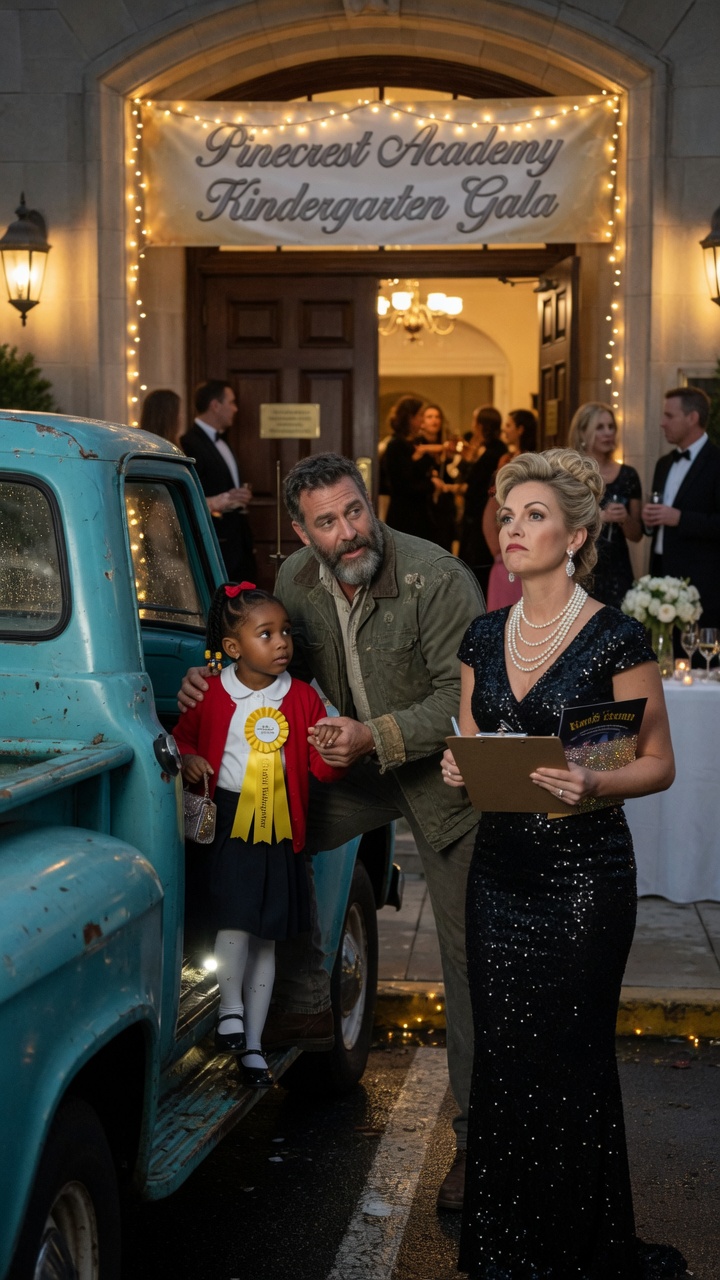
“Private education is not for every child.”
Vivian Langley said it with a smile.
Then she turned to security and pointed at my daughter.
My 5-year-old Maddie stood beside me in her little blue dress, holding the paper star certificate her teacher had given her ten minutes earlier.
The certificate said:
Kindest Heart Award
Vivian had just taken the ribbon off it.
The ballroom was full of donors, alumni, trustees, wealthy parents, and champagne glasses that cost more than the shoes on my feet.
Everyone watched.
Some looked embarrassed.
Some looked entertained.
Most looked away.
That was what made me angry.
Not only Vivian’s cruelty.
The silence around it.
I looked down at Maddie.
Her eyes were wet.
“Daddy,” she whispered, “did I do something bad?”
I knelt in front of her.
“No, sweetheart. You did something good. Some adults just don’t know how to recognize it.”
Vivian’s smile tightened.
“Mr. Cole, please don’t make this scene worse.”
I stood slowly.
“Vivian, you have no idea what scene you just started.”
My name is Ethan Cole.
For most of my life, people underestimated me because of what I wore.
Work boots.
Plain jackets.
Old jeans.
A baseball cap with dust on the brim.
I was raised by a mechanic father and a mother who cleaned office buildings after midnight.
I learned early that people judge hands before they judge hearts.
Clean hands?
Respect.
Callused hands?
Service entrance.
I built my first company from construction cleanup jobs.
Then small renovation contracts.
Then rental properties nobody wanted.
Then affordable housing.
Then school campuses.
Then Northstar Properties.
By forty-two, I owned more land and development rights than most men with louder last names.
But I never learned to dress like money.
Maybe I refused.
Maybe I didn’t want Maddie growing up thinking wealth meant looking down on people.
Northstar had a public CEO, Helena Price.
Brilliant.
Sharp.
Better at boardrooms than I ever wanted to be.
I remained founder and majority owner, but mostly stayed out of the spotlight.
The business magazines called me “reclusive.”
The men at job sites called me Ethan.
I preferred that.
After Maddie’s mother died, I stepped even farther away.
Cancer does not care how rich you are.
Neither does grief.
For two years, it was just Maddie and me.
Breakfast disasters.
Bedtime stories.
School forms.
Hair bows I tied badly.
Tiny shoes by the door.
Questions I did not know how to answer.
“Does Mommy see my drawings?”
“Why do other kids have two people at pickup?”
“Can dads learn braids?”
Yes, dads can learn braids.
Badly at first.
Then better.
When Maddie turned five, I chose Rosemont Academy because its brochure promised kindness.
Not excellence.
Not prestige.
Kindness.
The campus sat on land Northstar owned through an education trust.
Years earlier, I had quietly helped rescue the school from bankruptcy.
New classrooms.
Playground repairs.
Teacher salary grants.
Scholarship fund.
All anonymous.
I did not want a plaque.
I wanted children treated well.
Especially children who came from families like mine used to be.
So I enrolled Maddie under my regular name.
No title.
No donor introduction.
No board pressure.
Just Ethan Cole, single father.
The first month told me everything.
Maddie’s teacher, Mrs. Reyes, was wonderful.
Warm.
Patient.
The kind of teacher who remembered which children needed extra time and which children pretended they didn’t.
But the administration?
That was different.
Director Vivian Langley ruled Rosemont like a country club.
Perfect hair.
Perfect pearls.
Perfect fake warmth.
She loved “diversity” in brochures.
She loved scholarship children in year-end videos.
She loved saying:
“Every child deserves opportunity.”
But she only loved opportunity when it sat quietly in the back and thanked rich people for existing.
The first time she met me, her eyes went straight to my jacket.
It was clean, but old.
I had come from a construction site.
“Mr. Cole,” she said, “do you work in facilities?”
“No.”
“Oh.” Her smile barely moved. “Contracting?”
“Something like that.”
She wrote something on her clipboard.
Something like that became my label.
At pickup, wealthy parents formed little circles near the front steps.
They talked about tennis clinics, skiing, speech coaches, organic meal plans, and “legacy placement.”
I stood by the fence with Maddie’s backpack over one shoulder.
Maddie didn’t care.
She ran to me every afternoon like I was the best thing at the gate.
That was enough.
Then the comments started.
A mother asked if Maddie was “on assistance.”
Another asked whether I knew Rosemont had “family participation expectations.”
Vivian once told me:
“We want every child to feel comfortable, but sometimes social environments can be… aspirational.”
I said:
“Maddie is five. She aspires to draw dinosaurs.”
Vivian did not laugh.
Maddie noticed more than I wanted her to.
One night, while I made dinner, she asked:
“Daddy, are we different from Rosemont families?”
“Yes.”
“Bad different?”
“No. Real different.”
She thought about that.
“Mrs. Reyes says real is good.”
“Mrs. Reyes is smart.”
Maddie smiled.
But I knew the school was hurting her in small ways.
Birthday parties she wasn’t invited to.
Parents who didn’t answer my messages.
Children repeating things they heard at home.
“Your truck is dirty.”
“My mom says your dad works for the school.”
“Your lunch smells like poor food.”
Maddie cried only once.
After that, she started giving half her lunch away to children who forgot snacks.
That was Maddie.
Hurt turned outward as kindness.
When Rosemont announced its annual Alumni Giving Gala, Mrs. Reyes asked if Maddie could receive a small kindness award during the children’s presentation.
“She has helped three new students adjust this semester,” she told me. “And she sits with anyone who’s alone.”
I looked at Maddie through the classroom window.
She was helping a boy fix a paper crown.
“She gets that from her mother,” I said.
Mrs. Reyes smiled.
“And maybe her father.”
I almost told her the truth then.
About Northstar.
The land.
The funding.
The scholarship trust.
But I didn’t.
Because part of me still hoped Rosemont could be good without knowing who I was.
That was naive.
Gala night was held in Rosemont’s alumni hall.
The building Northstar had renovated after a flood.
The building Vivian liked to call “a testament to donor vision.”
I came in my best jacket.
It was still plain.
Maddie wore a blue dress with little embroidered stars.
I had ironed it twice because I burned one sleeve the first time.
She held my hand and whispered:
“Do I look fancy?”
“You look like Maddie.”
“Is that enough?”
I squeezed her hand.
“Always.”
Inside, the hall glittered.
White flowers.
Gold lights.
A string quartet.
Waiters carrying trays.
Parents in gowns and tuxedos.
A large screen displayed donation goals.
Expanding Excellence Together
Maddie’s award happened early.
Mrs. Reyes called her name.
Maddie walked up, shy but smiling.
She received her paper star certificate and a little gold ribbon.
People clapped politely.
I clapped like my hands owed her interest.
She came running back.
“Daddy, I didn’t trip.”
“Best part of the night.”
Then Vivian appeared.
Her smile was thin.
“Mr. Cole, may I speak with you privately?”
We stepped near the side corridor.
Maddie stayed close to my leg.
Vivian looked annoyed that she could hear.
“Rosemont has reviewed your family’s enrollment situation.”
“My family’s what?”
“Cultural fit.”
There it was.
The phrase people use when they want discrimination to sound like administration.
Vivian continued:
“Maddie is a sweet child. But Rosemont families maintain certain expectations.”
“She won a kindness award ten minutes ago.”
“Yes, and that is lovely. But kindness is not the only standard.”
Maddie’s fingers tightened around mine.
Vivian looked down at her.
Then at me.
“Frankly, children from less aligned households often struggle socially here.”
I kept my voice even.
“Less aligned means what?”
She sighed like I was forcing her to be honest.
“Mr. Cole, families like yours lower the standard of our school.”
There it was.
Plain.
Ugly.
Real.
Maddie looked up at me.
“Daddy?”
Before I could answer, Vivian reached down and removed the gold ribbon from Maddie’s certificate.
“This was issued prematurely.”
Maddie’s face crumpled.
Vivian turned to a security guard near the entrance.
“Please escort Mr. Cole and his daughter out before the donor presentation begins.”
The guard hesitated.
Good man.
Not brave yet.
But hesitant.
The room had gone quiet.
Wealthy parents turned.
Some whispered.
One woman laughed softly into her champagne glass.
Vivian leaned closer.
“Private education is not for every child.”
That was when the ballroom doors opened.
Helena Price walked in.
Black suit.
Silver hair.
No smile.
Behind her came two Northstar attorneys, three Rosemont trustees, and the chair of the City Education Partnership carrying a velvet award case.
Vivian’s face changed instantly.
Power recognizes power.
“Ms. Price,” she said warmly, rushing forward. “We are so honored. We weren’t expecting Northstar until the donor presentation.”
Helena did not shake her hand.
She looked past Vivian.
Straight at me.
Then at Maddie’s wet eyes.
Her expression hardened.
“Ethan.”
The room shifted.
Vivian blinked.
“You two know each other?”
Helena walked to my side.
“Yes. He signs my board authority.”
Silence.
Vivian’s face went blank.
Helena turned to the crowd.
“Ladies and gentlemen, tonight’s donor presentation has changed.”
One of the attorneys connected a tablet to the screen.
The donation goal disappeared.
A new slide appeared.
Northstar Properties Founder’s Civic Education Medal
Then my name.
Ethan Cole
A gasp moved through the hall.
Helena continued:
“Mr. Cole is the founder and majority owner of Northstar Properties. He is Rosemont Academy’s anonymous lead donor, the funder of its scholarship wing, and the owner of the land under this campus through the Northstar Education Trust.”
Vivian took one step backward.
The security guard looked like he wanted to become invisible.
The mother with the champagne glass stopped smiling.
Maddie whispered:
“Daddy, is that you?”
I knelt beside her.
“Yes, sweetheart.”
“Are we in trouble?”
“No.”
“Is she?”
I looked at Vivian.
“Yes.”
Helena opened the velvet case.
Inside was the civic medal the city had planned to award me quietly for supporting early childhood education access.
I had agreed only because Helena insisted the award would help expand the scholarship fund.
Now, the timing felt like justice had excellent scheduling.
The City Education Partnership chair stepped forward.
“Mr. Cole, on behalf of the city, we honor your commitment to making private education accessible to working families.”
Working families.
The words landed like a hammer in that room.
Vivian tried to recover.
“Mr. Cole, I had no idea—”
I stood.
“That I had money?”
Her mouth opened.
Closed.
I continued:
“You knew my daughter had dignity. That should have been enough.”
Short.
Cold.
Final.
Helena handed me a folder.
“Ethan, the acquisition documents are ready.”
Vivian’s eyes widened.
“What acquisition?”
One trustee cleared his throat, pale.
Rosemont had been financially unstable for months.
Low enrollment in some programs.
Mismanaged fundraising.
An operating loan coming due.
The board had quietly approached Northstar about rescue financing.
After what I had seen at pickup, I had authorized a full review.
What we found was worse than instability.
Scholarship funds redirected toward donor events.
Working-class applicants discouraged.
Admission notes using phrases like “family presentation concerns.”
Teacher requests for classroom resources delayed while gala budgets grew.
Vivian’s salary bonus tied to “high-value family retention.”
High-value.
Meaning rich.
That afternoon, before the gala, Northstar had completed the purchase of Rosemont’s debt, property rights, and operating control pending trustee approval.
The trustees had signed because they had no better option.
Vivian had been too busy polishing donor speeches to read the room she was standing in.
Helena looked at her.
“As of tonight, Northstar Education Trust controls Rosemont Academy’s campus and operating rescue package.”
Vivian whispered:
“You can’t remove me.”
The lead trustee finally found his spine.
“Actually, we can.”
He turned to her.
“Vivian Langley, effective immediately, you are terminated as director of Rosemont Academy pending final investigation into discriminatory enrollment practices and misuse of scholarship funds.”
The room went silent.
Maddie looked up at me.
“Does terminated mean fired?”
“Yes.”
“Good.”
A few parents gasped.
I did not correct her.
Vivian’s face turned red.
“You cannot let a child speak to me that way.”
I looked at the ribbon still in Vivian’s hand.
“You took her award in front of a room full of adults.”
Vivian looked down like she had forgotten she was still holding it.
Helena reached out.
Vivian handed it over slowly.
Helena knelt in front of Maddie.
“This belongs to you.”
Maddie took it.
Then looked at Vivian.
“I was kind even when you weren’t.”
That broke the room more than anything I said.
Mrs. Reyes started crying near the back.
The investigation after the gala changed Rosemont completely.
Vivian’s office files told the story.
Emails discouraging “non-prestige households.”
Notes ranking parents by “network value.”
Scholarship candidates labeled “image risk.”
Complaints from teachers ignored when wealthy children bullied scholarship students.
Gala expenses pulled from funds intended for classroom support.
Vivian had built her reputation on inclusion while quietly turning the school into a velvet rope.
She tried to sue.
That failed quickly.
The contracts were clean.
The evidence was cleaner.
She claimed she had been misunderstood.
Then the recording from the gala surfaced.
Families like yours lower the standard of our school.
Private education is not for every child.
No misunderstanding survived those words.
No other elite school hired her.
No nonprofit board touched her.
The parents who had once treated her like a queen suddenly called her “always a little much.”
Of course.
People abandon cruelty quickly when it stops being fashionable.
But firing Vivian was not enough.
If I bought the school only to punish one woman, I would become another rich man collecting revenge.
That was not what Maddie needed.
It was not what Rosemont needed.
So we rebuilt.
The parent association was dissolved.
Admission policies were rewritten.
Scholarship funds were placed under independent oversight.
Teacher resource budgets were protected before event budgets.
No child could be removed for “culture fit” without a documented educational reason and external review.
No parent’s job could be used in admission scoring.
No donor could influence classroom placement.
And every year, the school would reserve seats for children from working, single-parent, and service-industry families.
I created the Maddie Cole Open Door Scholarship.
Maddie hated the name at first.
“It sounds like I’m a building.”
I laughed.
“What should we call it?”
She thought very seriously.
“The Everybody Gets Crayons Fund.”
So that became the nickname.
Official documents said Open Door.
The children called it Crayons.
That was better.
Mrs. Reyes became interim director.
Then permanent director after the staff unanimously supported her.
Her first speech was simple.
“Children do not need polish before they deserve care.”
Parents cried.
Some because they believed it.
Some because they realized they had not.
The first scholarship open house under the new Rosemont looked very different.
No champagne.
No velvet ropes.
No donor-only lounge.
Just teachers, classrooms, snacks, and children running toward paint tables.
A father in a delivery uniform came straight from work.
He apologized at the door.
“I didn’t have time to change.”
Mrs. Reyes smiled.
“You had time to come. That matters more.”
I saw him swallow hard.
I knew that feeling.
Maddie gave his son a box of crayons.
“Blue is the best one,” she said. “But you can decide.”
That was the real victory.
Not Vivian being fired.
Not buying the school.
Not the civic medal.
The victory was watching a child walk into Rosemont without his parent feeling like an apology.
Months later, the school held a new winter performance.
No donor hierarchy.
No VIP seating.
Parents sat where they arrived.
Maddie stood onstage with her class, wearing paper stars on her head and singing half the words wrong with full confidence.
I sat in the front row.
Still in my plain jacket.
Still in work boots.
Because I never wanted Maddie to think respect required costume changes.
After the show, she climbed into my lap and touched the civic medal pin Helena had forced me to wear.
“Daddy, are you famous?”
“No.”
“Are you rich?”
I paused.
“Yes.”
She frowned.
“Why do you drive the old truck?”
“Because it still works.”
“Okay.”
That was children.
Straight to the point.
Then she asked:
“Can rich people be mean?”
“Yes.”
“Can not-rich people be mean?”
“Yes.”
“Then money doesn’t tell?”
I smiled.
“No, baby. Behavior tells.”
She nodded.
“I knew that.”
Of course she did.
She was five and already wiser than half the gala.
The media tried to turn me into a hero.
I refused most interviews.
The story was not that a rich father bought a school.
The story was that a school needed to be bought before it remembered children are not status symbols.
I gave one statement.
“Rosemont did not fail because one director was cruel. It failed because too many adults stayed quiet while cruelty sounded polite.”
That line traveled farther than I expected.
Good.
Let it.
Vivian disappeared from education circles.
Her husband quietly resigned from two boards after investigators reviewed connected fundraising contracts.
The families who had mocked Maddie avoided me for months.
Then some tried to be friendly.
I was polite.
Distance can be polite.
Maddie stayed Maddie.
She invited lonely children to play.
She gave away stickers.
She corrected adults who called Mrs. Reyes “interim” after she became director.
And every time she received an award, she checked to make sure nobody could take the ribbon back.
That part hurt.
Healing takes time.
One afternoon, I found the original Kindest Heart ribbon in her desk drawer.
Pressed flat.
Safe.
I asked:
“Why keep it there?”
She shrugged.
“So I know where it is.”
I sat beside her.
“No one will take it again.”
She looked at me.
“You promise?”
“I promise.”
That was when she climbed into my arms and cried for the first time since the gala.
Not loud.
Not dramatic.
Just a little girl finally letting fear leave her body.
I held her until she was done.
That was fatherhood.
Not buying schools.
Not signing contracts.
Holding the child after the battle everyone else thinks is already over.
A year later, Rosemont’s enrollment changed.
More teachers stayed.
More scholarship families applied.
More working parents joined classroom events because meetings were offered at realistic times.
The gala became a community dinner.
No champagne towers.
No donor ranking.
Every family brought something.
A surgeon brought salad.
A mechanic brought ribs.
A nanny brought rice.
A billionaire brought store-bought cookies because he forgot until the last minute.
That billionaire was me.
Maddie told everyone.
“Daddy can buy a school but not bake.”
Accurate.
At the dinner, the new scholarship children received welcome boxes.
Inside each one:
Crayons.
Books.
A school shirt.
And a card that said:
You do not have to be fancy to belong here.
Maddie helped write it.
I watched a single mother read the card and cover her mouth.
I knew she had probably heard some version of what Vivian said to me.
Families like yours.
Not the right fit.
Maybe next year.
Private education is not for every child.
Now her child was inside.
Not as charity.
As a student.
That was why I bought the school.
Not to throw Vivian out.
Though I admit that part felt good.
I bought it so the door would stop judging the shoes of the people walking through it.
Money can buy buildings.
It can buy donor walls, gala flowers, and polished speeches about opportunity.
But it cannot buy decency.
It cannot disguise contempt forever.
And it cannot defeat a plain-dressed single father who stays quiet only until someone tries to make his child feel too poor to belong. 💔✨
So choose a side:
Stand with Ethan and Maddie Cole, the father and daughter who turned a public humiliation into scholarships for every ordinary child Rosemont once ignored…
Or defend Vivian Langley, the director who tried to expel a kindergartener for “class fit” and lost the school she used as her throne.
Share this if you believe a child’s place in a classroom should never depend on how expensive their parent looks at the door. 👇🚨