Part 1
The Hallway of Gold and Silence
The hallway looked like a place where secrets were buried under gold and silence.
It did not merely stand between one room and another. It seemed to remember. It held its stillness with the solemn patience of an old palace corridor, as though every polished surface had once heard a confession and chosen never to repeat it.
Gold rested there like a quiet burden. Silence gathered there like dust no hand could sweep away.
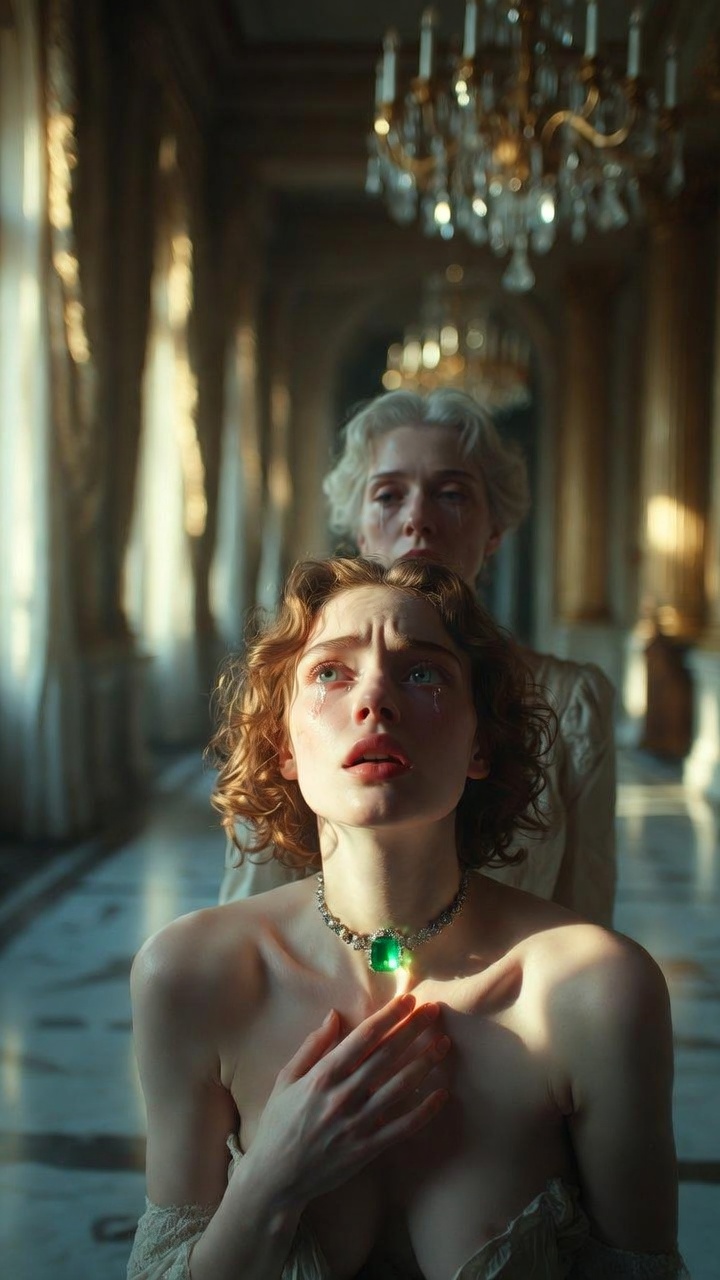
Sunlight spilled through towering windows, turning the marble floors into liquid light. The brightness did not make the place feel warm. It made it feel watched. Every pale gleam along the stone seemed to tremble with something unspoken, something hidden beneath beauty too carefully kept.
The marble shone as if water had been poured across it and frozen into brilliance. Light stretched over it in long, wavering bands, and the corridor became almost dreamlike, almost unreal, a passage made not only of stone and glass, but of memory.
Crystal chandeliers hung above.
They did not need to move to command attention. They waited in the high air, glittering faintly, each cut surface catching the sun and breaking it into fragments. Small fires of light clung to them, delicate and cold. They were beautiful, yes, but their beauty had the air of something guarded.
No footstep was mentioned. No voice broke the hush. No hand reached for a door.
Only the hallway remained.
It looked grand enough for ceremony, yet grave enough for mourning. It looked as though many people might have crossed it in splendor, and yet the deeper truth of it belonged to what had been concealed there. The gold did not speak. The silence did not soften. The light only revealed the surface.
Beneath that surface, the feeling of buried secrets endured.
There was no need for thunder. No need for a warning bell. The corridor itself carried the weight. Its towering windows, its shining floor, its suspended crystal, its severe and gilded quiet all seemed to form one still sentence, unfinished and waiting.
Sunlight spilled through towering windows, turning the marble floors into liquid light. Crystal chandeliers…
Part 2
Sunlight spilled through towering windows, turning the marble floors into liquid light, and in that bright, merciless glow, the single word seemed to break apart everything Elena had ever believed.
“Daughter.”
The woman had spoken it softly, almost as if she feared the palace itself might punish her for saying it aloud. Yet the word did not fade. It remained between them, trembling in the gilded corridor, sharper than a blade and heavier than grief.
Elena stopped breathing.
For a moment, she was no longer a young woman standing beneath crystal chandeliers. She was a child again, small and sleepless, listening to other children speak of mothers who brushed their hair and fathers who lifted them into their arms. She was the quiet girl who had learned to smile when people pitied her. She was the girl who had been told there was no one left to claim her.
No mother had come.
No father had written.
No family had searched.
“No,” Elena whispered.
The woman’s eyes filled before Elena could step away, but Elena did step away. One careful step. Then another. Her hand rose at once to the emerald necklace at her throat, as though the jewel itself might shield her from the thing just spoken.
“No,” she said again, and this time her voice shook with anger. “That is not possible. My parents are dead.”
The woman’s face twisted, not with offense, not with wounded pride, but with a pain so old it had become part of her features. She looked as though she had been carrying a funeral inside her for twenty years.
“They told you that,” she said quietly. “Because I made them.”
The corridor seemed to tilt beneath Elena’s feet.
Somewhere beyond the high windows, the day continued in its ordinary course. Servants passed in distant rooms. A clock may have been counting the hour. The world did not know that one life had just cracked open beneath a chandelier.
Elena knew.
She stared at the woman before her—the elegant stranger with pale trembling hands, with tears gathering silently, with eyes that had looked at the emerald as if it were not a jewel but a returned ghost.
“What did you say?” Elena asked.
The woman came nearer, though slowly now, as one approaches a frightened animal or a child waking from a terrible dream.
“Twenty years ago,” she began, “I had a child.”
Her voice faltered. Her fingers closed around the edge of a nearby vanity, polished and gold-trimmed, as if the carved wood were the only thing keeping her upright.
“A girl,” she continued. “A beautiful little girl. But my family said she would ruin everything.”
Elena did not move.
The woman swallowed, and the sound was small in the grand hall.
“My marriage. My name. My place in the world. They said no one would forgive me. They said no door would remain open. They said the child had to disappear before anyone knew she existed.”
There were cruelties that arrived with shouting, and cruelties that arrived dressed in silk. Elena understood, with a coldness spreading through her chest, that this had been the second kind.
“You are lying,” she said.
But the words had little strength. They were not conviction. They were defense.
The woman shook her head, and the tears finally broke free.
“I wish I were.”
Elena’s fingers tightened around the emerald. The stone had always been the only beautiful thing that truly belonged to her. She had worn it through loneliness, through hunger for answers, through birthdays that felt like small memorials. She had believed it was a keepsake from the dead.
Now it felt like a witness.
“I was weak,” the woman said. “I was young, and frightened, and surrounded by people who spoke as if fear were wisdom. I let them take you away.”
Elena’s lips parted, but no sound came.
“I told myself you would be safer away from this house,” the woman continued. “Safer from scandal. Safer from my family. Safer from the life that had already begun to close around me like a cage.”
She looked at the necklace.
“I gave you that emerald because I could not bear for you to vanish without one part of me going with you. I thought if fate had any mercy, I would find you again.”
At this, Elena almost laughed, but the sound died before it was born.
Mercy.
That was what people called hope when they had done something unforgivable.
“Why now?” Elena asked. Her voice was low, but it cut cleanly through the hall. “Why say this now?”
The woman pressed one hand against her chest, as though the answer hurt her ribs.
“Because I thought you were gone forever. Because I was told the trail had ended. Because every year I searched less openly but never stopped searching in secret.”
She drew a broken breath.
“And then today, in this hallway, I saw that necklace on you.”
Silence returned.
But it was not the same silence as before. It was no longer empty, no longer merely grand, no longer made of marble and gold. It was crowded now. It held twenty years of withheld letters, locked doors, false names, unanswered prayers, and a child’s quiet belief that she had been unwanted from the beginning.
Elena’s eyes burned. She did not wipe them.
“You did not lose me,” she said.
The woman closed her eyes.
Elena took one step forward, not in forgiveness, but in judgment.
“You gave me away.”
The words struck the woman harder than any cry could have done. She bent slightly, as though something invisible had passed through her.
“I know,” she whispered.
Elena looked at her then—truly looked. She saw grief. She saw guilt. She saw love, perhaps, but love that had arrived late, dressed in mourning, asking to be recognized after it had failed the only test that mattered.
And beneath all that, Elena saw the truth she had never asked for.
A mother had lived.
A mother had known.
A mother had chosen silence.
“I grew up thinking I was a burden no one wanted,” Elena said. Her voice trembled, but it did not break. “Do you understand what that does to a child?”
The woman reached for her, then stopped before touching her sleeve.
“I never stopped wanting you.”
Elena’s mouth tightened.
“But you stopped fighting for me.”
At that, the woman’s hand fell.
Beyond them, the sun began to lower, and the golden light changed. It deepened along the marble floor. It touched the emerald at Elena’s throat and turned it bright, then dark, then bright again.
The woman leaned against the vanity. Her strength seemed to leave her all at once, not dramatically, not like a queen in a tale, but like an ordinary human soul finally crushed beneath the weight of its own choices.
“Please,” she whispered. “Just do not walk away.”
Elena stood very still.
There are moments in every life when the heart wishes to become two hearts. One to remember the hunger. One to accept the hand reaching out too late. Elena felt both inside her, warring in silence. She wanted the mother she had invented as a child. She did not know what to do with the woman who stood before her now.
The woman’s eyes dropped again to the necklace.
“There is one more thing,” she said faintly.
Elena’s breath caught.
The woman lifted her own hand and drew back the lace at her wrist. There, near the pulse, was a small birthmark shaped like a crescent, pale brown against the skin.
Elena went cold.
Slowly, almost unwillingly, she turned her left wrist upward.
Beneath the delicate bones of her own hand, the same crescent mark rested in the same place, as though one secret had been written twice.
No one spoke.
No denial could survive it.
No lie could cover it now.
The woman began to weep again, but Elena’s face grew strangely calm. The truth had come with proof, and proof did not heal. It only removed the last door through which doubt might escape.
After a long moment, Elena reached behind her neck.
The clasp of the emerald necklace gave way with a tiny sound.
The jewel fell into her palm, cool and familiar, yet changed forever. She had once thought it a blessing. Then a mystery. Now it was a chain made beautiful enough to be mistaken for love.
The emerald caught the last light of the sinking sun.
For one breath, it looked as though it were burning with green fire.
Elena stepped forward and placed it gently into the woman’s trembling hand.
The woman stared down at it, horrified.
“No,” she whispered. “Please.”
Elena’s eyes shone, but her voice was soft.
“You do not get to find me now.”
Then she turned.
She left the woman in the hallway of gold and silence. She left the emerald behind. She left the truth where it had finally risen from its grave, too late to become a home.