Part 1
He Walked Into a Biker Clubhouse With a Bruise Around His Eye — Then Asked the Strangest Question Any Man There Had Ever Heard
The Bruise in the Doorway
The first thing everyone noticed was the bruise.
It had spread dark and ugly around Justin Miller’s left eye, purple at the center and yellowing at the edges, the kind of mark adults pretend not to understand until a child stops trying to explain it. The second thing they noticed was that he did not belong there—not in a H***’s Angels clubhouse that smelled of engine oil, old wood, black coffee, and cigarette smoke baked into the walls.
The room went still.
Cards stopped mid-hand. A pool cue lowered. One man reached for the radio knob and turned the music down until the only sound left was the soft hum of the refrigerator and the boy’s shoes shifting against the floorboards.
Justin was eleven, skinny and pale, with a backpack hanging from one shoulder and fingers wrapped too tightly around the straps.
At the far end of the room, Robert Kane lifted his eyes from his coffee.
He saw the bruise.
He saw the trembling hands.
He saw, more than anything, the effort it took for that boy not to run back through the heavy door and disappear into whatever fear had pushed him there in the first place.
“You lost, kid?” Ben asked from the corner, not sharp—just careful.
Justin swallowed.
For a second, his chin dipped, and every man in the room seemed to know the shape of that almost-surrender. Some had learned it in foster homes. Some had learned it from fathers with belts. Some had learned it in houses where nobody called bruises by their real names.
Then Justin looked up.
His voice shook at first.
“Can you be my dad for one day?”
No one moved.
The question landed harder than an accusation, because it was too small and too desperate and too strange to be anything but true. Robert set his coffee down slowly, and the room seemed to lean toward the boy without a single chair scraping.
What Justin said next made the men stop looking at the bruise—and start looking at the door behind him.
Part 2
The Silence After the Question
The silence afterward was heavier than before—not the empty silence of men unsure what to say, but the loaded kind, as if every scar in the room had suddenly remembered the first time it had been made.
Robert Kane looked from Justin Miller’s bruised eye to the boy’s trembling hands, then around the clubhouse at the men who had gone still over cards, coffee, pool cues, and half-finished jokes, each of them wearing the same expression beneath the leather and gray beards and old tattoos—recognition.
Justin shifted on his worn sneakers.
He explained that Friday was career day, that everyone else was bringing a parent, that his father had died in Afghanistan four years earlier, and that his mother worked double shifts at the hospital because somebody had to keep the lights on in a house where the wrong man had begun filling the silence.
“And the bruise?” Diego asked.
Justin answered too quickly.
“I fell off my bike.”
Then his mouth folded in on itself, and the truth came out in pieces—Dale got angry when his mother was gone, Dale called him useless, Dale said he was just like his dead father, and at school a boy named Nicholas Bradford waited by the lockers with friends who shoved him into metal, stole his lunch, and once threw his father’s dog tags into the trash.
Robert’s jaw tightened.
“Why us?” Tommy asked, softer than anyone expected.
Justin looked at the room full of men people crossed streets to avoid, and his answer came without drama, which somehow made it worse—because they were not afraid of anybody, because Nicholas’s father was an important lawyer, because nobody stood up to Dale, and because he had thought maybe, just once, somebody could stand in his corner.
Robert did not look away.
“What time Friday?”
“Nine-thirty,” Justin whispered.
Robert turned toward the others. “Who’s free?”
Every hand went up.
The Morning the Windows Shook
Friday arrived under flat gray clouds, and Justin dressed before sunrise in the only button-up shirt he owned—the one his mother had bought for his father’s funeral—while the bruise around his eye faded at the edges but still sat there like an accusation no mirror could soften.
At school, Nicholas was waiting.
“Ready for career day, orphan boy?” he said, stepping close while Brett and Chase hovered behind him, and when Justin tried to pass, Brett shoved him into the lockers hard enough to make pain flash across his shoulder.
Justin bent for his notebook and kept walking.
Room 204 filled with parents who looked polished and safe—a doctor with a stethoscope, a pilot in uniform, a woman with brochures, and Tom Bradford in a tailored gray suit, smiling with the easy confidence of a man used to people moving aside when he entered.
At 9:25, Justin’s hands went slick.
At 9:30, nobody came.
Then, at 9:31, a low sound reached the windows, distant at first, then larger, deeper, rolling over the asphalt until the glass trembled in its frame and every head in the classroom turned toward the parking lot.
Thirty-two motorcycles entered in formation.
Chrome flashed beneath the cloudy sky, engines thundered through the school walls, and when the bikes stopped in a sharp V, the sound cut out all at once—leaving behind a silence so complete even Mrs. Peterson forgot the papers in her hand.
Robert came through the classroom door first.
“Justin Miller,” he said.
Justin stood.
“We’re here for you, kid.”
Strength Without Cruelty
The room broke into whispers, but the bikers did not posture, threaten, or perform; they spoke about engines, balance, repair work, charity rides, children’s hospitals, and escorting a*** women into courtrooms so they would not have to walk through fear alone.
Ben put one hand on the back of a chair and told the students that a brotherhood did not mean hurting people who were weaker—it meant standing between danger and someone smaller.
Miguel stepped forward.
“I grew up in a house where love looked like a fist.”
Mrs. Peterson’s eyes filled.
“Real strength is not hurting people,” Miguel said. “Real strength is protecting them.”
Then Robert turned to Justin in front of the entire class and said the words that made Nicholas stop smirking, made Tom Bradford’s face tighten, and made Justin stand straighter than he had in years.
“You asked us to be your dad for one day,” Robert said. “Family does not work by schedule. You’re stuck with us now.”
The applause came hard and honest.
Outside, Tom Bradford tried to dismiss the whole thing as a performance, but Robert met his polished smile without blinking and told him his son’s treatment of Justin stopped that day—not as a request, not as a warning, but as a promise.
The Door Opened Before the Blow
By afternoon, the video was online; by evening, half the town had watched it; by Monday, Dale had seen it enough times to come home drunk, furious, and loud, slamming the front door so hard it struck the wall while Justin sat alone at the kitchen table doing homework.
“You think you’re special now?” Dale shouted.
Justin rose too fast.
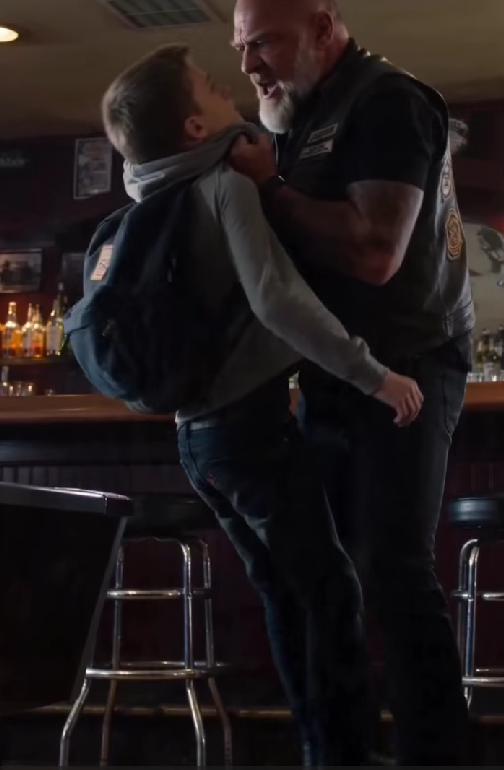
Dale grabbed him by the shirt and lifted him forward until his feet nearly left the floor, beer on his breath, rage in his hands, humiliation burning through every word as he snarled that Justin already had a father figure right there.
Justin closed his eyes.
“You’re not my father.”
The blow never landed.
The front door opened, and Robert stepped inside, followed by Ben, Diego, Tommy, and two more men who filled the small living room until Dale suddenly seemed much smaller than his own anger.
Robert’s voice stayed low.
“Not your house. Lease is in Jennifer Miller’s name.”
Diego placed a manila folder on the kitchen table—photographs of Justin’s bruises, school nurse notes, teacher statements, screenshots of Dale’s threats to Jennifer, dates, patterns, evidence gathered quietly and carefully because men who had survived violence knew the difference between a single bad night and a life being crushed.
Dale’s face lost color page by page.
“You’ve got two choices,” Robert said. “Pack tonight, leave, and never contact them again—or police, protective orders, domestic violence charges, child a*** charges, and every page in that folder goes public.”
Dale packed while six bikers watched.
No one touched him.
No one needed to.
The Other Boy at the Gate
When Jennifer came home, Justin was eating pizza at the kitchen table inside a half-circle of leather vests, and after Robert told her Dale was gone, she sat down hard, covered her mouth, and cried through her fingers with the kind of relief that shakes the whole body.
Life did not fix itself overnight.
Justin still flinched when doors opened too fast, but afternoons at the clubhouse slowly changed the shape of his days—homework beside toolboxes, lessons in oil checks, ratchets, socket wrenches, and extra fries slipped to him by Tommy without ceremony.
Then Robert noticed Nicholas.
The bullying had stopped completely, but Nicholas looked worse—thin, rumpled, hollowed out behind the mouth that used to do all the damage, waiting alone outside the school gates for rides that came too late.
By Friday, Robert and Ben knew the truth.
Nicholas’s mother had died of cancer three years earlier, and Tom Bradford had buried himself in work, alcohol, and grief so thoroughly that he had mistaken absence for survival while his son turned loneliness into cruelty.
Robert went to Tom’s office.
“Your son is drowning,” he said, “and you’re too busy grieving your wife to notice.”
Tom tried to stand behind his suit and anger, but the questions cut through—when had he last eaten dinner with Nicholas sober, when had he truly asked about his day, when had he stopped being a father because being a widower hurt too much.
Something cracked.
“I don’t know how to be his father without her,” Tom admitted.
Ben slid a support group card across the desk, and Robert told him to bring Nicholas to the clubhouse youth program, where boys could build something instead of breaking people.
Where Pain Stopped
Nicholas arrived wearing suspicion like armor, and when he saw Justin sanding a shelf with Tommy, both boys froze beneath the smell of sawdust, warm metal, and coffee cooling on a nearby workbench.
“I’m sorry,” Nicholas said.
His voice cracked.
He apologized for the dog tags, the lockers, the names, all of it, and said he had been angry at his own life, which did not erase what he had done but finally named the wound beneath it.
Justin could have hated him.
Instead, he set down the sandpaper and asked if Nicholas wanted to help, because he was terrible at corners—and for the first time anyone in that room had ever seen, the bully looked only like a child.
“Yeah,” Nicholas whispered. “Okay.”
They changed after that, not cleanly and not quickly, but truly; Tom went to meetings, quit drinking, relapsed once, came back and told the truth, Jennifer returned to the nursing degree she had abandoned, and Justin grew taller, louder, stronger in ways that had nothing to do with fear.
The Name on the Metal
At graduation, Justin stood at the podium while his mother sat in the front row and thirty-two bikers lined the back wall, and he told the room that blood was biology, but family was who showed up when the world was breaking.
Robert looked down.
Afterward, he handed Justin a leather vest with a patch stitched across the back: HONORARY BROTHER — FOREVER FAMILY.
That should have been the ending.
But later that night, Justin found Robert alone behind the clubhouse beneath the yellow buzz of a security light, turning a small metal object in his hand with a look Justin had never seen on his face before.
Robert handed it to him.
The stamped name made Justin stop breathing.
STAFF SERGEANT DANIEL MILLER.
Robert told him then—the truth buried under years of war, drinking, shame, and survival—that he had known Justin’s father in Afghanistan, that they had served in the same unit, that Daniel Miller had saved Robert during an ambush outside Kandahar and taken the hit meant for him.
Justin’s hand shook around the tag.
Robert pulled out a faded photograph of two soldiers, filthy and sunburned, arms around each other, grinning into a light that had long since vanished from one of their lives.
One was young Robert.
The other was Justin’s father.
Alive. Laughing. Real.
Robert said Daniel had talked about his unborn child constantly and hoped, if he had a son, that the boy would be brave; then his voice broke as he admitted he had promised to help the family if he ever found them, only to lose years of himself before Justin walked through the clubhouse door.
“So when I asked if you could be my dad for one day…” Justin said.
Robert shook his head.
“Kid, I think your father answered before I did.”
They held each other there in the engine-cooled dark, one boy finding a piece of the father he thought death had taken completely, one man being forgiven for surviving, while the clubhouse laughed behind them and Jennifer called Justin’s name from inside.
Because the strangest truth was never that bikers had become a boy’s family—it was that love had been riding toward him long before he knew how to ask.