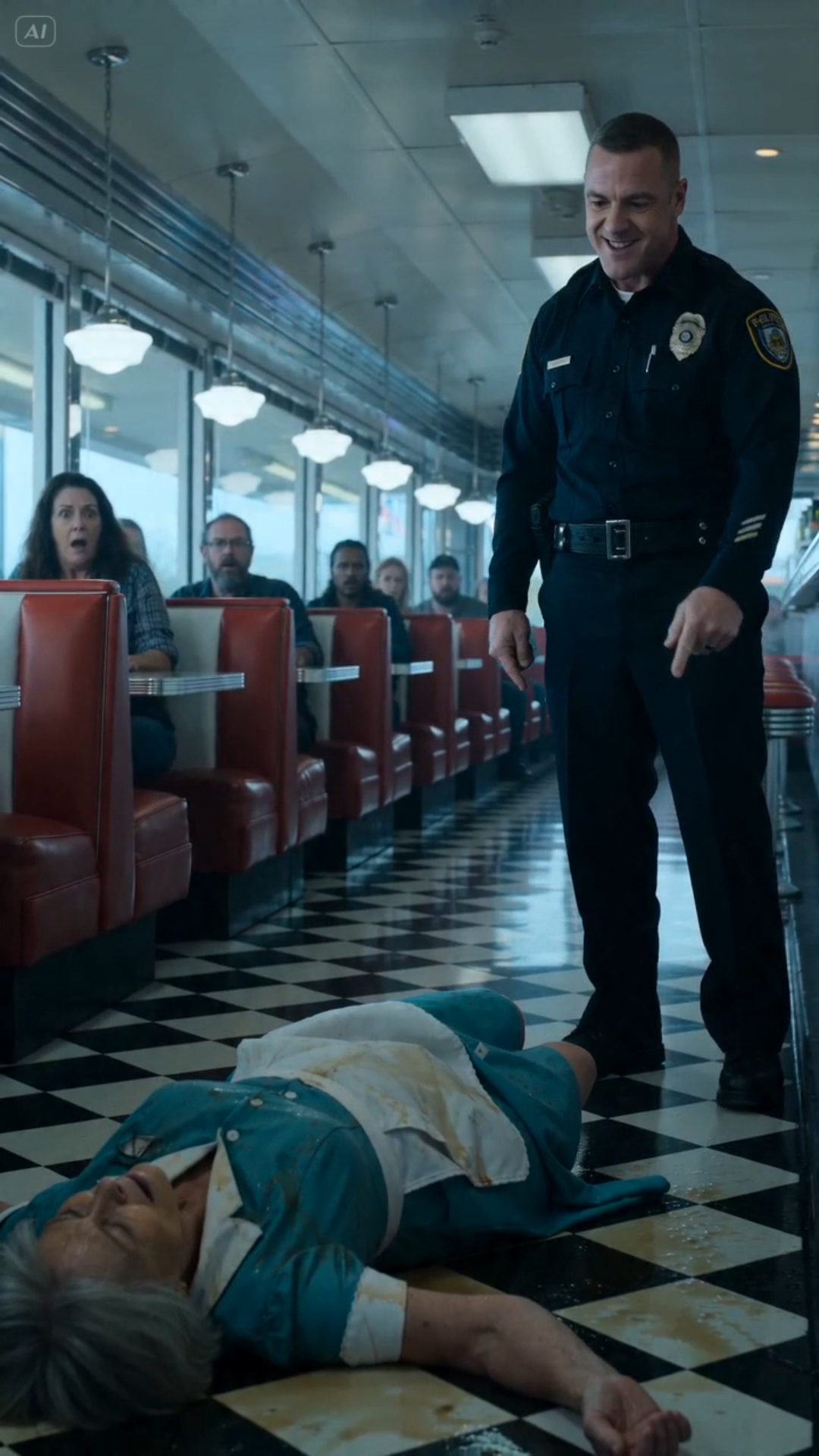
The coffee pot slipped from Martha Lane’s trembling hand and shattered across the tile floor.
Hot coffee splashed under the long service counter, spreading in a dark puddle between broken glass. A man in booth four froze with his fork halfway to his mouth. Two college girls stopped whispering over pancakes. Behind the counter, the old neon clock buzzed softly, as if even time did not want to move.
Officer Daniel Cross did not flinch.
He stood in front of Martha in a black police uniform, tall and broad, his badge catching the daylight from the diner windows. He was close enough that Martha could smell leather, aftershave, and the cold air he had brought in from outside.
Martha Lane was sixty-eight years old. Her silver hair was tied neatly behind her head. Her teal diner uniform had coffee stains near the pocket, and her white apron was already damp from a morning rush that had started at 5:30 a.m. She had worked at Lane’s Diner for thirty-one years—first as a waitress, then as manager, then as owner after her husband died.
She knew how to handle rude customers.
She knew how to calm drunk truckers.
She knew how to tell teenagers to stop throwing fries without embarrassing them.
But Officer Cross was different.
He did not want service.
He wanted fear.
“You’re making this harder than it has to be, Martha,” he said, voice low but loud enough for nearby customers to hear.
Martha stepped back until her hip hit the counter.
“I told you I don’t have anything.”
Cross leaned in.
“And I told you not to lie to me.”
The diner was supposed to feel safe. Red cushioned booths lined the walls. Metal tables reflected the morning sun. The long counter smelled of coffee, bacon, and toast. Outside, pickup trucks rolled past Main Street like any other Tuesday in rural Kentucky.
But inside, everyone had gone silent.
At the back of the diner, in the last red booth beneath an old Coca-Cola sign, Jax Turner slowly raised his head.
He was a large man in his late forties, thick beard, heavy shoulders, black leather biker jacket covered in patches. He had been sitting alone for almost an hour with one untouched coffee and a plate of eggs he barely touched. Most people had noticed him when he walked in, then decided it was safer not to stare.
Jax placed his mug on the table.
The soft ceramic click sounded louder than it should have.
Cross kept his eyes on Martha.
“You found a phone,” he said. “You found it in this diner. I want it.”
Martha’s lips trembled. “People leave phones here all the time.”
“Not this one.”
“I don’t know what you mean.”
Cross smiled.
It was not a smile meant to comfort.
“You want a health inspection today? Fire code review? Tax audit? Maybe a complaint that you’re serving expired meat?”
Martha’s hand tightened on the counter edge.
The customers looked down.
Nobody wanted trouble with a cop in a small town.
That was how men like Daniel Cross survived.
They did not need everyone to help.
They only needed everyone to look away.
Then Jax stood up.
The floor seemed to notice him first. His boots creaked against the old tiles as he stepped out of the booth and walked down the aisle. Slow. Calm. Not rushing. Not posturing.
Cross finally turned.
Jax stopped beside Martha, then placed himself between her and the officer.
His voice was flat.
“Wrong move.”
Cross looked him up and down.
“Well,” he said. “If it isn’t the Black River Saints.”
Jax did not answer.
Cross glanced at the biker patches on his jacket.
“What’s this? Some outlaw thinks he’s going to save grandma?”
Martha whispered, “Jax, please.”
Cross’s eyes flicked to her.
“You know him?”
Jax moved half a step closer, blocking Martha completely.
“She knows enough people to not be alone.”
Cross laughed.
“You boys always think leather makes you bulletproof.”
“No,” Jax said. “But body cameras make you nervous.”
The officer’s smile disappeared.
A customer near the window slowly lowered his coffee cup.
Cross took a step toward Jax.
“Are you threatening a police officer?”
Jax looked down at the shattered glass and spilled coffee.
“No. I’m standing between you and an old woman you’re trying to scare.”
Martha closed her eyes briefly.
She had never wanted this.
Three nights earlier, a young woman named Kelsey Moore had stumbled into Lane’s Diner just before closing. She was twenty-two, soaked from rain, with a split lip and fear in her eyes. Martha had seen that kind of fear before. Her own sister had worn it decades earlier, before anyone in town used words like domestic violence out loud.
Kelsey asked to use the restroom.
Then she stayed too long.
When Martha knocked, Kelsey opened the door and whispered, “If a cop comes in looking for me, please say I was never here.”
Martha brought her soup.
Kelsey cried into it.
The story came out in broken pieces. Officer Daniel Cross had been “helping” her after she reported her boyfriend for assault. Then Cross started showing up at her apartment. Calling her at night. Warning her that women with “messy lives” should be careful accusing men who knew judges.
When she tried to file a complaint, the paperwork vanished.
When she tried to leave town, Cross found out.
Kelsey had recorded him in the diner parking lot the week before. On her phone was a video of Cross threatening to plant pills in her car if she talked to Internal Affairs.
Then Kelsey disappeared.
The phone remained under booth three.
Martha found it while sweeping.
And Daniel Cross had been coming every morning since.
But Martha had not called a lawyer first.
She had called the number Kelsey scribbled on a napkin.
Jax Turner. If I vanish, he’ll know what to do.
Jax arrived the next day.
He watched the video.
His face changed only once—when Kelsey said, “Please, Daniel, let me go home,” and Cross answered, “Home is wherever I say it is.”
Then Jax said, “That’s my daughter.”
Now he stood in Lane’s Diner, staring at the man who had hunted her.
Cross tilted his head.
“You should walk away.”
Jax’s jaw tightened.
“Funny. That’s what she tried to do.”
Cross’s eyes sharpened.
For the first time, he understood.
“You have no idea what she is.”
Jax stepped closer.
“She is my daughter.”
The diner sucked in one breath.
Martha covered her mouth.
Cross’s expression shifted—not guilt, not fear yet, but calculation.
Then he laughed softly.
“You mean the addict who stole from her employer and ran?”
Jax did not move.
Cross continued, louder now, performing for the room.
“She’s unstable. She lies. She has a record.”
Martha spoke from behind Jax, voice shaking but clear.
“She has a video.”
Cross went still.
There it was.
The thing he had come for.
The thing Martha was supposed to be too frightened to keep.
Jax reached inside his leather jacket.
Cross’s hand moved toward his gun.
“Don’t,” Cross snapped.
Jax slowly removed a folded document and placed it on the counter.
Not a weapon.
A court order.
Cross stared at it.
“What is this?”
“Emergency preservation order,” Jax said. “For your phone records, dashcam logs, bodycam archive, and every file connected to Kelsey Moore.”
Cross’s face paled.
Martha looked at Jax, stunned.
The diner door opened.
Two people in dark suits entered first. Behind them came Sheriff Laura Gaines from the neighboring county, followed by a federal investigator with a badge on her belt.
Cross turned.
His voice sharpened. “What is this?”
The federal investigator stepped forward.
“Officer Daniel Cross, step away from Mrs. Lane.”
Cross forced a laugh.
“You’re making a mistake. This man is a biker gang member interfering with a police matter.”
The investigator looked at Jax.
“Mr. Turner has been cooperating with our office for forty-eight hours.”
Jax looked at Cross.
“Wrong move,” he said again, quieter this time.
Cross looked around the diner.
Customers had their phones out now.
Every single one.
For years, his badge had entered rooms before he did. It made people quiet. It made people careful. It made people doubt what they had seen.
But now he was standing in the middle of a diner full of witnesses.
And the old woman he thought he could scare had not been alone.
The investigator held out her hand.
“Badge and weapon.”
Cross did not move.
Sheriff Gaines stepped closer.
“Daniel. Don’t make this worse.”
Something ugly passed over Cross’s face.
Then he unpinned his badge and placed it on the counter beside the broken coffee glass.
The sound was small.
Martha would remember it forever.
The phone was recovered from the flour bin in the diner kitchen, wrapped in plastic and hidden behind a sack of pancake mix. The video was worse than Martha had described. Cross had not only threatened Kelsey. He had named other officers, a judge’s clerk, and a local prosecutor who had “fixed” complaints before.
By sunset, Kelsey Moore was found alive in an abandoned rental cabin outside Franklin County.
She was dehydrated, bruised, and terrified, but alive.
When Jax entered her hospital room, she turned away at first.
“I told you not to find me,” she whispered.
He sat beside her bed.
“You also told Martha to call me.”
Kelsey’s face crumpled.
“I didn’t think you’d come.”
Jax swallowed hard.
“I was late. Not gone.”
She cried then, and the biker who scared half the town held his daughter’s hand like it was made of glass.
The investigation that followed tore open more than one bad cop’s career.
Cross had been using his badge to silence women who reported politically connected men. Complaints disappeared. Evidence went missing. Women were arrested on sudden warrants after they asked too many questions. Some lost custody hearings. Some lost jobs. Some left town.
Martha’s diner had become a quiet refuge without her fully realizing it.
She gave soup to scared women.
Let them use the back phone.
Wrote badge numbers on order pads.
Remembered names.
That made her dangerous to men like Cross.
And it explained why he wanted Lane’s Diner sold.
Mayor Russell Pike and a development group had been pressuring Martha for months. They wanted to tear down the diner and build a chain pharmacy. But investigators discovered the development group had been laundering payments to Cross and two city officials. Lane’s Diner was not just in the way of progress.
It was in the way of witnesses.
Cross took a plea deal only after the bodycam backups were found on a private server he thought had been wiped. He pleaded guilty to witness intimidation, evidence tampering, assault, coercion, and civil rights violations.
Mayor Pike resigned, then was indicted.
Several old cases reopened.
Women who had been called liars were called back to court.
Not all of them got justice.
But none of them were invisible anymore.
At Cross’s sentencing, Martha testified in her teal uniform.
The prosecutor asked why she had hidden Kelsey’s phone instead of handing it to the police.
Martha looked at Cross.
“Because the police were standing in front of me asking for it.”
The courtroom went silent.
Then she added, “And because that girl was hungry and scared in my diner. When someone comes in hungry and scared, you feed them first. Then you figure out who’s chasing them.”
Jax testified after her.
He did not make speeches.
He simply said, “My daughter asked for help. Martha Lane heard her. Daniel Cross heard her too. Only one of them acted like a human being.”
Cross received a long sentence.
Not long enough for Kelsey.
Not long enough for Martha.
Not long enough for Jax.
But long enough that he walked out of the courtroom in handcuffs while the women he had tried to silence watched him lower his head.
A month later, the Black River Saints rode into town again.
This time, nobody panicked.
They came with lumber, paint, tools, and bad coffee.
They repaired Lane’s Diner.
Fixed the broken floor tiles.
Replaced the front sign.
Installed security cameras Martha could control from behind the counter.
Built a ramp by the entrance because Martha’s knees had started hurting and she kept pretending they did not.
Jax fixed the jukebox himself.
It still skipped on one Elvis song.
Martha said that gave it character.
Kelsey came back to the diner one quiet Sunday morning.
She sat in booth three.
The same booth where she had hidden the phone.
Martha brought her pancakes without asking.
Kelsey looked down at the plate.
“I don’t know how to thank you.”
Martha slid into the seat across from her.
“Eat while it’s hot.”
Kelsey laughed through tears.
Jax stood near the counter, pretending not to hover.
Martha looked at him and said, “Sit down before you wear a hole in my floor.”
He obeyed.
That surprised everyone.
A year later, Lane’s Diner had a new line painted beneath the front window:
HOT COFFEE. WARM MEALS. SAFE TABLES.
People came from three counties.
Some for pie.
Some for breakfast.
Some because they had heard there was a diner where no one asked why you were scared before giving you a place to sit.
Martha kept a phone behind the counter with numbers taped beside it: shelters, legal aid, sheriff’s office, crisis line, Jax Turner.
She did not call it charity.
She called it running a diner properly.
On the anniversary of Cross losing his badge, Martha held a small dinner after closing. No reporters. No speeches planned. Just regulars, survivors, Jax’s club, Sheriff Gaines, and Kelsey, who now worked with a victim advocacy center.
But Martha stood anyway, holding a coffee mug.
“I’m not good at speeches,” she said.
Everyone laughed because Martha was famous for speeches about baseball, gas prices, and people who left pennies as tips.
She ignored them.
“This place has always fed people,” she said. “But I used to think food was the whole job. It isn’t. Sometimes people need a witness. Sometimes they need a phone. Sometimes they need someone big and scary to stand between them and a bully.”
Jax looked down, embarrassed.
Martha smiled.
“And sometimes the big scary one needs someone to remind him he’s still a father.”
Kelsey reached for Jax’s hand.
He let her.
Martha raised her mug.
“To safe tables.”
Everyone lifted their cups.
Before they drank, the bell above the door rang.
A young woman stood at the entrance, one hand gripping a little boy’s shoulder, the other holding a folded paper so tightly it had wrinkled.
Her eyes were red.
Her coat was too thin.
Martha saw the fear before the woman spoke.
So did Jax.
The diner went quiet, but not cold.
Martha set down her mug and walked toward the door.
“Come in, honey,” she said gently. “Sit anywhere you like.”
The woman’s face trembled with relief.
Jax stepped aside to clear a path.
And outside, beneath the newly painted sign, the evening light caught the diner window just right.