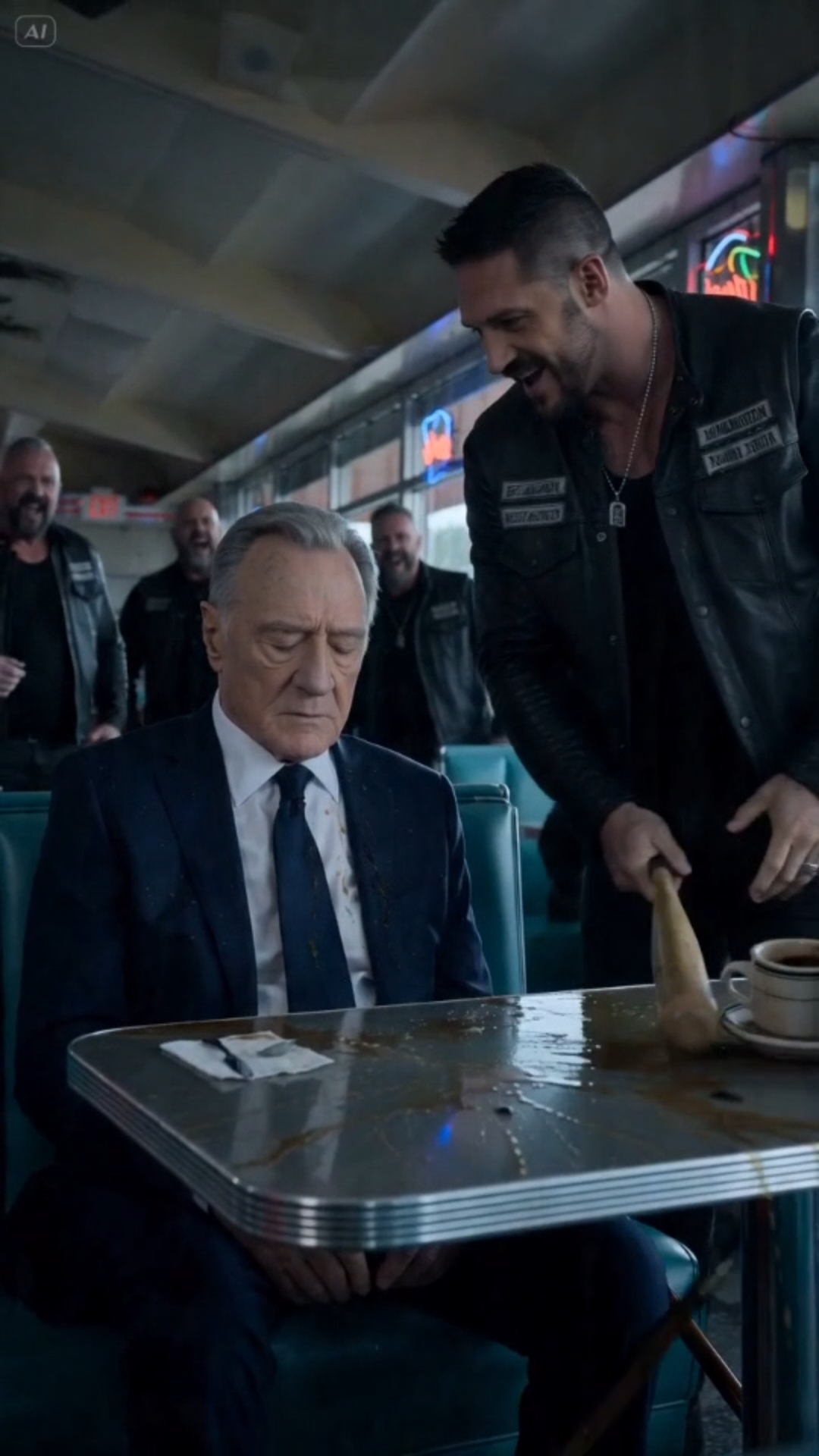
Samuel Bennett chose the booth by the window because it let him see the parking lot.
That was what everyone assumed, anyway.
An old man liked to see the road.
An old man liked to watch the headlights pass by.
An old man liked to sit where the waitress would not forget to refill his water.
But Samuel Bennett had chosen that booth for another reason.
From there, the camera above the pie case could see his face.
The camera near the register could see the table.
And the large front window could show everything that happened outside when the time came.
Ruby’s Diner sat off Route 19 in northern Georgia, the kind of place where truckers stopped at two in the morning and local deputies knew the breakfast special by heart.
The booths were teal leather.
The floor was worn black-and-white tile.
The lights hummed softly overhead.
On a good night, the place smelled like coffee, fried onions, and old country songs.
On that night, it smelled like rain, motor oil, and trouble.
Samuel sat alone with a glass of water in front of him.
He wore a dark blue-gray suit, a white dress shirt, and polished brown shoes that looked too formal for the diner.
His silver-white beard was neatly trimmed.
His silver hair was combed back.
A wooden cane rested in his right hand.
He looked like a retired banker.
Or a church deacon.
Or somebody’s grandfather waiting for a ride home.
Across the diner, eight men in black leather watched him from the booths.
They had been there for nearly an hour, laughing too loud, kicking their boots under the tables, making the young waitress, Maggie, nervous every time she passed.
Their leader was Travis Walker.
Forty years old.
Thick beard.
Broad shoulders.
Black leather vest.
The kind of man who had learned early that most people would rather step aside than be stepped on.
Travis had been running that part of the county for years without ever holding office.
He did not own the diner.
But he acted like he did.
He did not own the parking lot.
But everyone knew not to park in the row his men liked.
He did not own the people.
But he had a way of making them feel borrowed.
Samuel lifted his water glass and took a slow sip.
Maggie approached his table with a pot of coffee.
“Can I get you anything else, sir?” she asked quietly.
Samuel looked up at her.
She was maybe twenty-seven, tired around the eyes, with a name tag that had been cracked down the middle.
“No, ma’am,” he said. “You’ve been very kind.”
Maggie glanced toward Travis and his men.
“Just don’t pay attention to them,” she whispered. “They get bored.”
Samuel’s eyes softened.
“Men like that don’t get bored,” he said. “They look for permission.”
Maggie did not understand, but something in his voice made her step back slowly.
At the far booth, Travis noticed the exchange.
His smile widened.
He stood.
The diner grew quieter without anyone being told to stop talking.
Travis walked toward Samuel’s table like a man crossing a stage.
His boots clicked against the tile.
His men leaned back to watch.
Samuel did not move.
Travis stopped beside the table and looked down at him.
“Well,” Travis said, “ain’t you dressed up pretty for a place like this.”
Samuel folded both hands over the handle of his cane.
“I like to be presentable.”
The bikers laughed.
Travis looked at Samuel’s suit, then at the water glass.
“You lost, old man?”
“No.”
“You waiting on somebody?”
“Yes.”
Travis bent closer.
“Hope they’re bigger than you.”
Samuel looked at him for the first time.
His eyes were calm.
Not weak calm.
Not frightened calm.
The kind of calm that made Travis’s smile twitch for half a second.
Then Travis reached down and yanked the cane from Samuel’s hand.
Maggie gasped from behind the counter.
Samuel’s fingers opened.
He did not fight for it.
Travis spun the cane once like a toy.
“Nice stick,” he said. “You need this to walk?”
Samuel looked at the cane.
Then at Travis.
“I need it less than you think.”
The laughter from the booths got louder.
Travis’s face hardened.
He did not like being answered.
He lifted the cane and slammed it down onto the water glass.
The glass shattered with a sharp crack.
Water exploded across the table and splashed over Samuel’s suit.
Pieces of glass scattered near the edge of the booth.
The cane bounced off the table and dropped to the floor.
For one brief moment, Samuel flinched.
Just once.
Enough to satisfy Travis.
Then the old man became still again.
The diner fell into an ugly silence before the bikers broke into laughter.
Travis spread his arms.
“Look at that,” he said. “Made him blink.”
Samuel looked down at the water spreading across his lapel.
He brushed it once with his fingertips.
Maggie hurried forward with a towel, but Samuel gently raised one hand.
“No need,” he said.
Travis turned away, laughing, and walked back toward his men.
“Somebody get Grandpa a bib,” one of the bikers shouted.
More laughter.
Samuel looked at the cane on the floor.
He did not pick it up.
He looked at the broken glass.
Then he reached inside his suit jacket and took out a black smartphone.
That was when Maggie noticed something strange.
His hand was not shaking.
Not even slightly.
Samuel raised the phone to his ear.
Travis saw it and turned back.
“What, old man?” he called. “Calling your nurse?”
Samuel waited one second.
Then he spoke into the phone.
“It’s me,” he said. “Bring them.”
Two words changed the room.
Bring them.
Not help me.
Not come get me.
Not I’m scared.
Bring them.
Travis’s smile faded just enough for everyone to notice.
“What did you say?” he asked.
Samuel lowered the phone but kept it in his hand.
“I wasn’t speaking to you.”
The first headlights appeared outside the window.
Then the second.
Then the third.
Three black SUVs rushed into the parking lot and braked in a straight line facing the diner.
Their headlights swept across the glass, filling the room with white light.
Every biker turned.
Maggie froze behind the counter.
Travis stared through the window.
The engines went quiet.
Doors opened.
Men and women stepped out in dark suits.
Not thugs.
Not bodyguards.
Not bikers.
Attorneys.
Investigators.
County officials.
And one woman in a navy coat with a gold badge clipped at her belt.
Travis’s men stopped laughing.
Samuel remained seated.
The broken glass still lay in front of him.
The water still stained his suit.
The cane still rested on the floor where Travis had left it.
The woman in the navy coat entered first.
Behind her came a tall man carrying a folder and another man holding a tablet.
Maggie stepped aside as they crossed the diner.
Travis lifted his chin, trying to recover his old confidence.
“This is private property,” he said.
The woman looked at him.
“No, Mr. Walker,” she said. “It is not.”
Travis blinked.
Samuel finally stood.
Slowly.
Without the cane.
He rose from the booth with the kind of controlled strength that made the whole room remeasure him.
He picked up his phone and placed it on the wet table.
Then he looked at Travis.
“You never ask who owns the place before you act like you do.”
Travis’s jaw tightened.
“What’s that supposed to mean?”
The tall man opened the folder.
“Ruby’s Diner, the parking lot, the adjoining garage, and the two vacant lots behind it were transferred this afternoon to Bennett Community Holdings.”
Travis stared at him.
Samuel buttoned his wet suit jacket.
“That would be me.”
Maggie covered her mouth.
The bikers shifted in their seats.
Travis forced a laugh.
“You bought a diner? Congratulations. Want a parade?”
“No,” Samuel said. “I wanted witnesses.”
The woman in the navy coat stepped forward.
“Mr. Walker, my office has been investigating multiple complaints of intimidation, property damage, and forced payments from business owners along Route 19.”
Travis’s face changed.
Just a little.
But Samuel saw it.
So did the investigators.
The woman continued.
“We had statements. We had reports. We had people too scared to testify.” She glanced at the shattered glass. “Now we have fresh video from three angles, in a property owned by the victim, with a room full of witnesses.”
Travis looked toward the cameras.
For the first time all night, he seemed to notice them.
The one above the pie case.
The one near the register.
The one pointed at the window.
Samuel had chosen the booth carefully.
Travis looked back at him.
“You set me up.”
Samuel’s expression did not change.
“No. I sat down. You chose the rest.”
One of the bikers stood halfway.
The woman in the navy coat turned her head.
“Sit down.”
He sat.
Travis swallowed.
“You think a broken glass means something?”
“No,” Samuel said. “A broken glass is just a broken glass.”
He looked toward Maggie.
Her eyes were wet.
“But making a twenty-seven-year-old waitress pay you two hundred dollars every Friday so her car doesn’t get keyed means something.”
Maggie looked down.
The room went still.
Samuel turned back to Travis.
“Breaking Mr. Alvarez’s hand because he refused to sell you his garage means something.”
One of Travis’s men cursed under his breath.
“Sending men to stand outside Mrs. Holloway’s bakery until she signed over her lease means something.”
Travis’s face went pale.
Samuel stepped closer, careful to avoid the glass.
“And threatening Ruby Dawson before she died?” Samuel said quietly. “That meant something to me.”
Travis froze.
For the first time, confusion crossed his face.
“You knew Ruby?”
Samuel looked around the diner.
At the teal booths.
At the counter.
At the old neon clock above the kitchen window.
Then his voice softened.
“Ruby was my sister.”
Maggie inhaled sharply.
Most people in town only knew Ruby Dawson as the woman who had run the diner for forty years.
They remembered her pouring coffee.
Remembered her calling everyone honey.
Remembered her feeding deputies during snowstorms and slipping free pie to kids who came in hungry after school.
They did not know about the brother who had left Georgia at eighteen, joined the Army, built a logistics company from one truck and a borrowed warehouse, then spent the rest of his life sending Ruby money she never wanted to take.
Ruby had been proud.
Too proud.
When Travis Walker began squeezing businesses, she never told Samuel.
When his men parked motorcycles across her entrance, she never told Samuel.
When they broke the back window and left a note telling her to sell, she never told Samuel.
She only called him once.
Three weeks before she died.
Not to complain.
Not to ask for help.
Just to say, “Sammy, if anything happens to me, don’t let them take the diner.”
Samuel had promised.
Then Ruby was gone.
Heart failure, the doctor said.
Maybe that was true.
Maybe fear helped it along.
Samuel would never know.
But he knew this.
The diner had been her whole life.
And Travis Walker had tried to take it before the funeral flowers were dry.
Samuel’s eyes returned to Travis.
“I came home to bury my sister,” he said. “Then I stayed to learn who had been feeding off this town.”
Travis looked toward his men, but none of them moved.
The power in the room had shifted completely.
It was no longer leather and noise.
It was paper, cameras, witnesses, and consequences.
The man with the tablet placed it on Samuel’s wet table and turned the screen toward the room.
Video clips played silently.
Travis shoving Mr. Alvarez against a garage door.
Two bikers blocking the bakery entrance.
A man leaving an envelope under Ruby’s diner door.
Maggie wiping tears from her face beside the trash bins while one of Travis’s men stood too close.
Travis stared at the screen.
His mouth opened, but no words came out.
Samuel looked at him.
“You built your kingdom on people being too tired to fight back.”
He pointed gently at the broken glass.
“Tonight, you mistook patience for weakness.”
The woman in the navy coat nodded to the officers who had entered behind her.
“Travis Walker,” she said, “you need to come with us.”
Travis backed up one step.
“This is ridiculous.”
No one agreed with him.
Not even his own men.
The officers moved in.
There was no dramatic fight.
No last heroic swing.
No Hollywood speech from Travis.
Just a large man realizing that fear stopped working the moment nobody was afraid anymore.
As they led him toward the door, Travis turned his head toward Samuel.
“You think you won?”
Samuel looked at the diner around him.
At Maggie.
At the old counter.
At the booths Ruby had loved.
“No,” he said. “She did.”
Travis was taken outside.
The SUVs’ lights flashed against the rain.
One by one, his men were questioned.
Some were released.
Some were not.
By sunrise, half the county knew what had happened at Ruby’s Diner.
By noon, every business owner on Route 19 had heard that Travis Walker had finally been arrested.
By Friday, Maggie no longer had to put cash in an envelope.
Mr. Alvarez reopened his garage with a new sign.
Mrs. Holloway put fresh peach pies in her bakery window.
And the motorcycles stopped parking across Ruby’s front door.
Two weeks later, Samuel returned to the same booth.
The glass had been replaced.
The floor had been polished.
The teal seats still had cracks in them, but Maggie said she liked them that way.
“They feel honest,” she told him.
Samuel smiled.
His cane leaned beside the table again.
Repaired.
Not perfect.
A brass band wrapped around the place where Travis had cracked it.
Maggie poured him coffee this time.
“Cream?” she asked.
“Black is fine.”
She hesitated.
“Mr. Bennett?”
“Yes, ma’am?”
“Are you selling the diner?”
Samuel looked toward the kitchen, where Ruby’s old recipes were taped inside a cabinet door.
“No.”
Maggie’s shoulders relaxed.
“I’m giving it away.”
She nearly dropped the pot.
“What?”
Samuel slid a folder across the table.
Inside was a new management agreement.
Maggie’s name was on the first page.
So were the names of three other employees who had kept the diner alive while Ruby was sick.
“You’ll run it,” Samuel said. “All of you. I’ll cover repairs for the first year. After that, the profits are yours, as long as the doors stay open to anyone hungry enough to walk in.”
Maggie stared at him.
“I can’t accept this.”
Samuel looked at the booth across from him.
In his mind, Ruby was still there.
Younger.
Laughing.
Calling him Sammy.
“Yes,” he said softly. “You can.”
Maggie began to cry.
Samuel pretended not to notice.
Outside, the morning sun rose over the parking lot where the three SUVs had once appeared like thunder.
Inside, coffee brewed.
Bacon hissed on the grill.
A trucker walked in and asked if breakfast was still being served.
Maggie wiped her eyes, lifted her chin, and smiled.
“All day,” she said.
Samuel sat by the window with his repaired cane beside him.
He looked older than he had the night Travis smashed the glass.
But somehow stronger too.
Because power, he knew, was not the ability to scare a room silent.