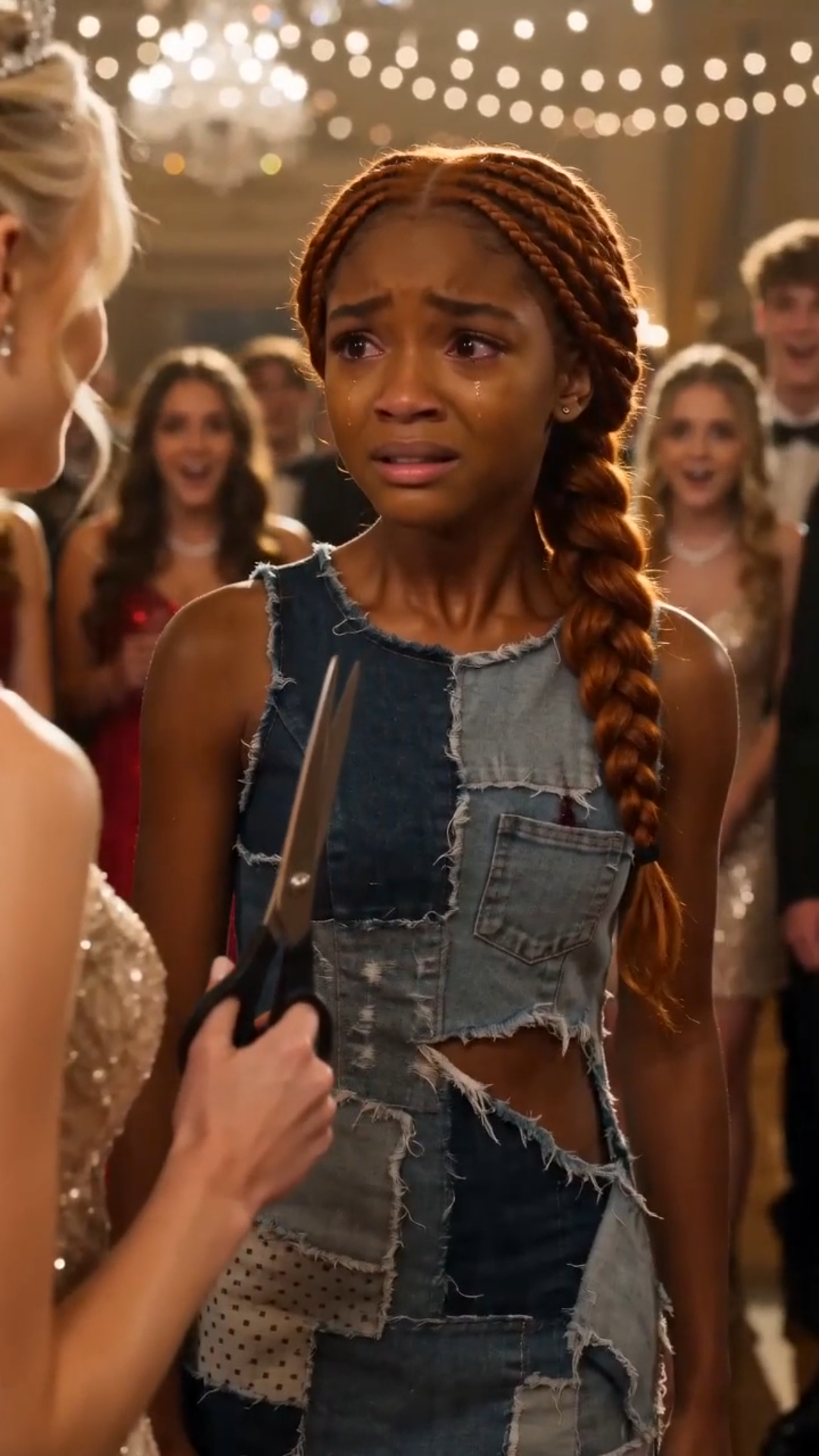
Maya Ellis stood in the middle of the prom ballroom, trying not to look down at the torn edge of her dress.
But everyone else was looking.
That was the worst part.
Not the laughter.
Not the gasps.
Not even Brielle Carter standing in front of her with a pair of silver scissors still in her hand.
It was the way the room had gone hungry for her humiliation.
The high school prom ballroom glowed under warm string lights.
Gold reflections moved across the polished dance floor.
Students in satin gowns, rented tuxedos, glittering heels, and pinned flowers turned from the punch table, the photo corner, and the slow dance circle.
For one beautiful hour, Maya had almost believed she belonged there.
Then Brielle stepped forward.
Brielle Carter, prom royalty before the crown was even announced.
Blonde hair twisted into a perfect formal style.
Gold sequin dress catching every light in the room.
Small tiara placed just high enough to look playful and cruel at the same time.
She had been smiling when she approached Maya.
That should have warned her.
“Cute dress,” Brielle had said.
Maya knew better than to answer.
Her handmade patchwork denim dress had taken three months to finish.
Every square of fabric had been cut, washed, measured, and sewn by hand at her kitchen table.
Dark denim.
Light denim.
Soft faded blue.
A few copper stitches.
A fitted bodice.
A wide skirt that moved when she walked.
It was not expensive.
It was not designer.
But it was hers.
And more than that, it had been her mother’s dream first.
Maya’s mother, Alana Ellis, used to collect worn-out denim jackets from thrift stores and say, “The best fabric already survived somebody else’s life.”
After Alana died, Maya found the unfinished pattern tucked in an old sewing box with a small note folded inside.
For your first big night. Finish it when you’re ready to be seen.
So Maya finished it.
Not perfectly.
But honestly.
And when she stepped into prom, she felt her mother with her.
Until Brielle lifted the scissors.
One quick snip.
Not near Maya’s body.
Not enough to ruin the whole dress.
Just one outer patch near the lower side edge.
The patch loosened and curled downward.
A small tear.
A big message.
The students gasped.
Then someone laughed.
Brielle lowered the scissors slightly, eyes glittering.
“Did you really think that rag belonged at prom?”
Maya looked down.
The damaged denim patch hung from the dress like a wound.
Her throat closed.
She could hear phones being raised.
Whispers moving.
A boy muttering, “That’s messed up,” but not stepping forward.
A girl near the wall covering her mouth, but not speaking.
Everyone seemed shocked.
No one seemed brave.
Maya lifted her eyes.
“Why would you do that?”
Brielle smiled.
“Because someone had to tell you.”
The words landed softly.
That was how Brielle did cruelty.
Never shouting.
Never looking out of control.
She kept her voice light enough that adults could call it drama if they arrived too late.
“You show up here in scraps,” Brielle continued, “and act like this is some inspirational movie.”
A few students laughed again, weaker this time.
Maya blinked hard.
“It was my mother’s pattern.”
For one second, something in the room shifted.
Even Brielle paused.
Then her expression sharpened.
“Well,” she said, “maybe your mother had bad taste too.”
That was the moment Maya felt the tears come.
Not from the dress.
Not from the crowd.
From hearing her mother turned into a punchline beneath string lights.
She wanted to run.
She wanted to disappear into the bathroom and pull every stitch apart so no one could touch it again.
But her feet would not move.
She stood there with her copper-brown braids over one shoulder, warm brown skin shining beneath the ballroom lights, and eyes filling with tears she refused to let fall.
Brielle lifted the scissors again, not to cut, just to remind everyone she still held them.
“Relax,” she said. “It’s just denim.”
Maya whispered, “It’s not just denim.”
The ballroom doors opened.
No one noticed at first.
Then the music seemed to fade.
A cold kind of silence spread from the entrance toward the dance floor.
Students turned.
Teachers near the refreshment table straightened.
Brielle’s smile flickered.
A woman had entered the ballroom.
She was Black, elegant, and older, perhaps in her early sixties, with short platinum hair, pearl earrings, a long black coat, and a silver-gray silk scarf resting at her throat.
She walked slowly.
Not because she was unsure.
Because she knew the room would make way.
There are people who enter loudly.
And there are people who enter with the weight of a name everyone suddenly remembers.
This woman was the second kind.
Evelyn Monroe.
Even students who did not know fashion knew the Monroe name.
Monroe House.
Monroe Foundation.
Monroe scholarships.
Monroe gowns on actresses at award shows.
Monroe suits in magazines their mothers kept on coffee tables.
The prom committee had begged for her to attend because her foundation had sponsored the school’s arts program.
No one expected her to arrive late.
No one expected her to walk directly toward Maya.
Brielle’s hand lowered.
The scissors trembled slightly.
Evelyn stopped beside Maya and looked first at the damaged dress.
Not with pity.
With recognition.
Her eyes moved over the seams.
The denim patches.
The copper thread.
The torn lower edge.
Her face changed.
Slowly.
Pain first.
Then memory.
Then something that looked like grief arriving after a very long trip.
She turned to Brielle.
Her voice was calm enough to freeze the room.
“You just humiliated my granddaughter.”
The silence that followed was absolute.
Maya stopped breathing.
Brielle’s face went pale.
Someone near the back whispered, “Granddaughter?”
Maya looked up at Evelyn.
“I’m sorry,” she said automatically, though she had no idea what she was apologizing for.
Evelyn turned to her then.
The coldness left her face.
“Oh, child,” she whispered. “You have nothing to apologize for.”
Maya’s eyes searched her face.
“I don’t know you.”
Evelyn’s expression broke.
“I know.”
Those two words carried more sadness than the entire ballroom could hold.
Brielle tried to speak.
“Mrs. Monroe, I didn’t—”
Evelyn turned back to her.
“Do not make your apology about what you did not intend. Make it about what you chose.”
Brielle closed her mouth.
The principal, Mr. Lawson, hurried across the floor.
“Mrs. Monroe, perhaps we should handle this privately.”
Evelyn did not look away from Brielle.
“Was this private when she was laughed at?”
Mr. Lawson stopped.
Maya felt heat rise in her face.
She did not want hundreds of eyes on her.
But for the first time, the eyes did not feel like a cage.
They felt like witnesses.
Evelyn looked down at the scissors.
“Put them on the table.”
Brielle obeyed.
The tiny sound of metal touching wood felt louder than the music had been.
Evelyn bent carefully and lifted the damaged edge of Maya’s dress between two fingers.
Maya stiffened.
Evelyn immediately released it.
“May I?” she asked softly.
Maya blinked.
No adult had asked before touching the dress that night.
She nodded.
Evelyn lifted the torn patch again and turned it toward the light.
On the inside of the fabric, nearly hidden by stitching, was a small line of copper thread shaped like a tiny crescent.
Maya frowned.
“I didn’t put that there.”
Evelyn’s hand began to shake.
“No,” she said. “Your mother did.”
Maya’s heart thudded.
“You knew my mom?”
Evelyn closed her eyes for one breath.
“Alana was my daughter.”
The room vanished.
Not literally.
But Maya no longer heard the whispers.
No longer saw Brielle.
No longer felt the damaged edge of the dress.
Only those words.
Alana was my daughter.
Maya stepped back.
“No.”
Evelyn reached into the inside pocket of her black coat and removed a small folded photograph.
She held it out.
Maya took it with trembling fingers.
In the photo, a young woman stood on a studio floor covered with fabric. She was laughing, wearing paint-splattered jeans and holding up a denim dress pattern.
Beside her stood Evelyn Monroe, younger, elegant, proud.
Between them, spread across a table, was the early sketch of Maya’s prom dress.
Maya’s throat tightened.
“That’s my mom.”
Evelyn nodded.
“She was seventeen.”
Maya looked at the photograph again.
“My grandma told me Mom didn’t have family.”
Evelyn’s face hardened with a different kind of pain.
“Your grandmother told you what she was told to say.”
Maya’s eyes lifted.
“What does that mean?”
Before Evelyn could answer, a woman pushed through the crowd.
Cynthia Carter.
Brielle’s mother.
Prom committee chair.
Blonde, polished, wearing a pearl-white cocktail dress and a smile that had been trained through years of charity luncheons.
“Evelyn,” Cynthia said too brightly. “This is a misunderstanding.”
Evelyn looked at her.
The temperature in the room seemed to drop.
“Cynthia.”
Maya looked between them.
Brielle looked as if she might faint.
Cynthia’s smile trembled.
“These children get emotional. I’m sure Brielle meant no harm.”
Evelyn’s eyes narrowed.
“Your daughter cut a garment made from a Monroe archive pattern.”
Cynthia swallowed.
“I’m sure she didn’t know.”
“No,” Evelyn said. “But you did.”
The room went still again.
Cynthia’s face changed.
Only for a second.
But everyone saw it.
Maya’s voice came out small.
“What is happening?”
Evelyn turned toward her.
“Your mother was my only child. She left home at eighteen after a terrible argument with me. I believed she wanted no contact. Later, letters came back unopened. Phone numbers stopped working. By the time I learned she had passed, I was told she had no child.”
Maya’s fingers tightened around the photograph.
“I was five when she died.”
Evelyn covered her mouth.
A quiet gasp moved through the students.
Maya whispered, “Nobody came.”
Evelyn’s eyes filled.
“I would have.”
Cynthia stepped forward.
“This is not the place.”
Evelyn turned on her.
“It became the place when your daughter put scissors to my granddaughter’s dress.”
Cynthia’s polished mask cracked.
“I did what your attorneys failed to do. I protected your brand.”
Maya stared at her.
Evelyn’s voice lowered.
“What did you say?”
Cynthia looked around and realized she had spoken too much.
But fear makes people careless.
So does guilt.
“Alana was unstable,” Cynthia said. “She ran away. She married beneath her. She would have embarrassed the Monroe name.”
Maya flinched.
Evelyn’s face went still.
“You were my assistant then.”
“I was loyal.”
“You intercepted the letters.”
Cynthia said nothing.
That silence answered.
Evelyn took one step closer.
“You told me Alana wanted nothing from me.”
“She didn’t deserve—”
Evelyn’s voice cut through the ballroom.
“You do not get to decide what a daughter deserves from her mother.”
Brielle began crying.
“Mom?”
Cynthia did not look at her.
Evelyn looked at Mr. Lawson.
“I want security to preserve every camera angle from this room. I want the scissors documented. And I want Mrs. Carter removed from every committee connected to my foundation.”
Mr. Lawson nodded quickly.
Cynthia laughed bitterly.
“You think you can rewrite history because of one dress?”
Maya looked at the damaged denim.
Then at the photograph.
Then at Evelyn.
For the first time all night, she spoke clearly.
“No,” Maya said. “Because of my mother.”
The room fell quiet for her now.
Not Evelyn.
Not Brielle.
Her.
Brielle wiped her face.
“Maya, I’m sorry.”
Maya looked at her.
“You were sorry when you got scared.”
Brielle sobbed harder.
Maya did not comfort her.
She had spent too many years comforting people who hurt her and called it forgiveness.
Evelyn removed her silver scarf and gently placed it around Maya’s shoulders.
It did not cover the damaged dress.
That mattered.
She did not hide the cut.
She framed it.
Then she turned to the crowd.
“This young woman walked into prom wearing a piece of her mother’s unfinished art. You were invited to witness it. Some of you chose laughter instead.”
Students lowered their eyes.
A boy near the front whispered, “I’m sorry.”
Maya heard him.
She did not answer.
Not yet.
That night, Maya did not stay for prom court.
She left with Evelyn through the same ballroom doors that had opened like judgment and closed like protection.
Outside, under the warm spring night, Evelyn asked only one question.
“May I call you tomorrow?”
Maya looked at her.
Not grandmother.
Not yet.
Not family.
Not so fast.
But not stranger anymore either.
“Yes,” Maya said.
The next months opened old rooms.
Cynthia Carter had worked for Evelyn Monroe during the years Alana disappeared from the family.
She had intercepted letters, redirected calls, and quietly helped attorneys classify Alana as estranged and unreachable.
Why?
At first, everyone assumed greed.
But the truth was uglier.
Cynthia had built her own career by stepping into the space Alana left behind. She became the dependable assistant, then the foundation liaison, then the woman who advised which students were “Monroe material.”
Maya’s existence threatened everything.
Not financially.
Historically.
Maya was proof that Cynthia had not protected the Monroe name.
She had severed it.
When Evelyn’s legal team investigated, they found copies of letters Alana had sent.
One included a photo of Maya at age three, wearing denim overalls and holding a crayon.
On the back, Alana had written:
She has your eyes when she studies fabric.
Evelyn held that photo for almost an hour without speaking.
Then she called Maya.
Not to explain.
To apologize.
“I was powerful enough to build a fashion house,” Evelyn said, “but not brave enough to doubt the people who made my silence comfortable.”
Maya listened quietly.
“I’m angry,” she said.
“You should be.”
“At you too.”
“I know.”
“I don’t want money to make this weird.”
“Then we will not start with money.”
“What do we start with?”
Evelyn’s voice softened.
“Your mother.”
So they did.
Every Saturday, Maya visited Evelyn’s studio.
Not the public showroom.
The old workroom.
The place Alana had drawn patterns on brown paper, argued about hems, and stitched crescent marks inside everything she made.
Maya learned that the tiny copper crescent was Alana’s private signature.
Evelyn learned that Maya liked loud music while sewing, hated pins between her teeth, and talked to fabric when it refused to behave.
“You do that like her,” Evelyn said once.
Maya paused.
Then kept sewing.
“Tell me again.”
So Evelyn did.
She told her again and again, until memories became bridges instead of wounds.
Brielle transferred schools after the video from prom spread.
Not because Maya posted it.
She did not.
But the crowd had filmed what happened before Evelyn arrived.
People always record cruelty.
They rarely expect justice to enter the frame.
Cynthia resigned from every board before she could be removed. Her social circle collapsed politely, which meant invitations stopped arriving and friends stopped returning calls.
Brielle wrote Maya a letter.
A real one.
No excuses.
No “if you felt hurt.”
No mention of stress, jealousy, or pressure.
Just truth.
I wanted people to laugh at you because I was afraid you were becoming special in a way I could not buy.
Maya read it once.
Then put it in a drawer.
Forgiveness, she decided, did not need a deadline.
One year later, Maya returned to the same ballroom.
Not for prom.
For the Monroe Young Designers Showcase.
She walked onto the stage wearing the repaired denim dress.
Not restored.
Repaired.
There was a difference.
The cut Brielle made was still visible, but now it had been framed with copper stitching and tiny blue glass beads. The damaged patch had become the center of the design.
Evelyn sat in the front row.
Crying openly.
Maya stood beneath the warm lights and looked out at students, teachers, designers, and young artists who came from schools that rarely saw their work treated as luxury.
“My mother started this dress,” Maya said. “I finished it. Someone tried to make the damage the story. So I made it part of the design.”
Applause rose.
Maya’s voice shook, but she smiled.
“For a long time, I thought handmade meant less than expensive. Now I know handmade means someone cared long enough to leave fingerprints.”
Evelyn pressed a hand to her heart.
Maya looked at her.
“This collection is called Seen.”
Behind her, models stepped out wearing denim, silk, copper thread, and patchwork built from donated fabric and family stories.
No two pieces matched.
Every one belonged.
After the show, Evelyn approached Maya backstage.
Alana’s old photo was in her hand.
“You brought her home,” Evelyn whispered.
Maya looked down at the picture.
“No,” she said. “She brought us back to each other.”
Evelyn opened her arms.
This time, Maya stepped into them.
Not because everything was healed.
Because healing had finally started telling the truth.
And in the ballroom where a girl once stood humiliated in a damaged handmade dress, Maya Ellis became what Brielle Carter never understood.
Not a charity case.
Not a joke.
Not a girl wearing scraps.
A Monroe.
An artist.